





Search

Educational Episodes: Hyperconverged Infrastructure (HCI)

Featured blog posts

Trending topics you shouldn't miss

All blog posts

Every post, every insight, all in one place
View:
Volodymyr Perishko
  • Volodymyr Perishko
  • January 22, 2024

How Can I Replace a Failed Physical Disk on Storage Spaces Direct in Windows Server 2022?

Step-by-step instructions on replacing a failed drive in S2D without breaking your cluster or data integrity.
Read more
Vitalii Feshchenko
  • Vitalii Feshchenko
  • January 21, 2024

VMware Tools 11: What’s This All About?

  Before starting to talk about new features and improvements, I suggest we take a little trip down memory lane.
Read more
Alex Samoylenko
  • Alex Samoylenko
  • January 18, 2024

Changes to VMware licensing policy at the end of 2023 

Broadcom’s $61 billion acquisition of VMware in 2022 has led to significant changes in the virtualization vendor’s licensing policy.
Read more
Oksana Zybinskaya
  • Oksana Zybinskaya
  • January 16, 2024

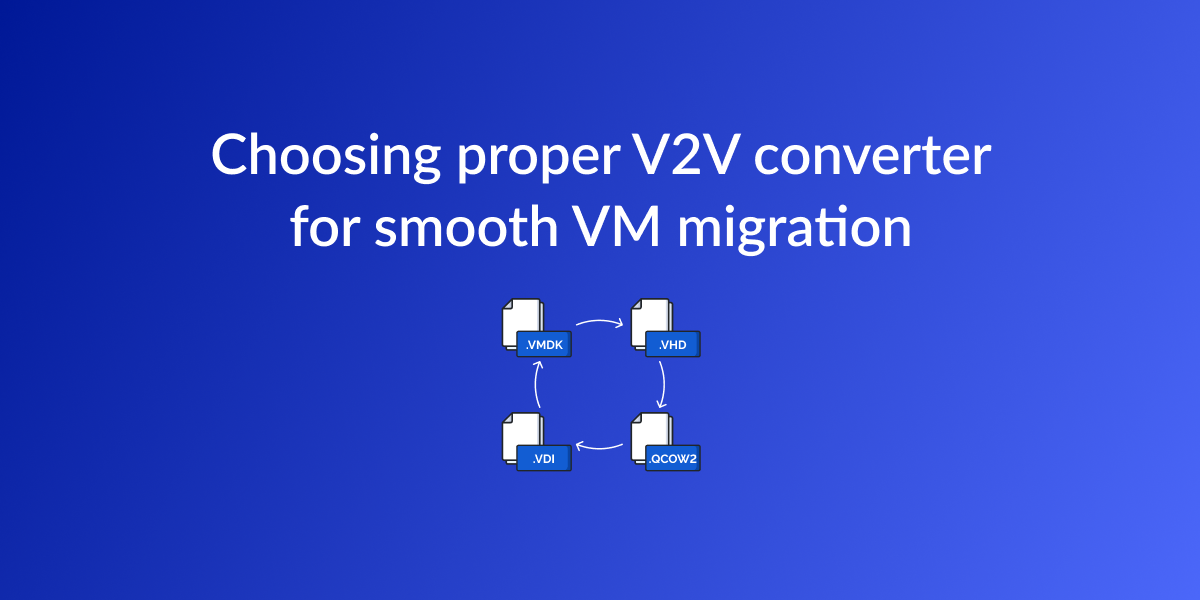
Choosing proper V2V converter for smooth VM migration

Migrating your VMs from one hypervisor to another may be a bit of a challenge if you don’t have some decent virtual machine converter at hand. Different hypervisors have their own proprietary VM formats: VMDK, VHD and VHDX, QCOW, you name it. The problem is that one VM format can be not supported on other platforms. In this case, a V2V converter is a must-have. Now, the question arises: which converter should I choose?
Read more
Volodymyr Perishko
  • Volodymyr Perishko
  • January 16, 2024

How to save disk space in Clustered File Servers on Windows Server 2016 using Data Deduplication feature

For that matter, I’ll create a file server of two types: “File server for general use” and Scale-Out File Server. For the latter, I’ll have two scenarios: VMs running and off. After that, I’m gonna evaluate the deduplication ratio using a free tool – StarWind Deduplication Analyzer. And finally, run data deduplication using the Windows Server 2016 Data Deduplication feature. We also need our storage shared, so for this purpose, I’ve decided on StarWind Virtual SAN Free.
Read more
Anton Vovchuk
  • Anton Vovchuk
  • January 16, 2024

Converged vs Hyperconverged Infrastructure. What’s the Difference?

Converged infrastructure (CI) simplifies IT with pre-configured systems, while hyperconverged infrastructure (HCI) optimizes resource utilization through a unified software-defined approach. Still unsure what to choose?
Read more
Diana Abo Harmouch
  • Diana Abo-Harmouch
  • January 11, 2024

What is the 3-2-1 Backup Rule? Why is it Important?

Every company faces the challenge of managing data, but have you considered the cost of losing it? Embrace the 3-2-1 Backup Rule – a foundation for robust data protection.
Read more
Vitalii Feshchenko
  • Vitalii Feshchenko
  • January 10, 2024

Virtualization: Performance Comparison

As you remember from my previous article, I have been interested in testing the performance levels of two virtual SAN configurations from different vendors. I got my results, but this experience prompted me to continue. Here, I’ve chosen to try another configuration for performance comparison, albeit with only a slightly different list of participants. Since no one needs an introduction from VMware vSAN, I’d like to say a few words about its companion – Ceph. Basically, it is an object-based software storage platform. I know that doesn’t sound epic at all, but Ceph is also completely fault-tolerant, uses off-the-shelf hardware, and is extremely scalable. The most interesting thing is that some Ceph releases apply erasure-coded data pools so that it would be a less resource-hungry solution than traditional replicated pools. In practice, that means the following: when you store an object in a Ceph storage cluster, the algorithm divides this object into data and coding chunks, stored in different OSDs (that way, the system could lose an OSD without actually losing the data). Now, that’s when I thought that theoretically, Ceph could make a good virtualization platform (proper configuration, of course), so I had to see whether it would be justified in terms of time and resources spent. Naturally, I hardly could have done it without a credible comparison, hence VMware vSAN (with a similar configuration, of course, otherwise it would make no sense). So, shall we?
Read more
Vladan Seget
  • Vladan Seget
  • January 10, 2024

VMware Announces new multi-topology vSAN Max Storage Architecture

Dive into VMware’s vSAN Max Storage Architecture. VMware unveils vSAN Max Storage Architecture with the latest vSAN 8 Update 2!
Read more