
Downtime is expensive. Whether it’s costing you thousands of dollars per minute or degrades user trust in a competitive market – business availability can’t be an afterthought. That’s why high-availability (HA) architectures are foundational to modern infrastructure.
Two HA architectures dominate: active-active and active-passive. Both keep services running when something fails, but they take very different paths to get there. This article covers how each works, where each one shines, where each falls short, and how to think about choosing between them – including the split-brain scenarios and data consistency headaches that don’t show up until you’re in production.
What is active-active vs active-passive?
At their core, the two architectures represent different philosophies about how redundancy should work and also depend on physical or network limitations.
In an active-active setup, multiple nodes operate simultaneously and share the incoming workload. Every node is live, serving traffic. If one node fails, the others absorb its load without manual intervention or noticeable disruption.
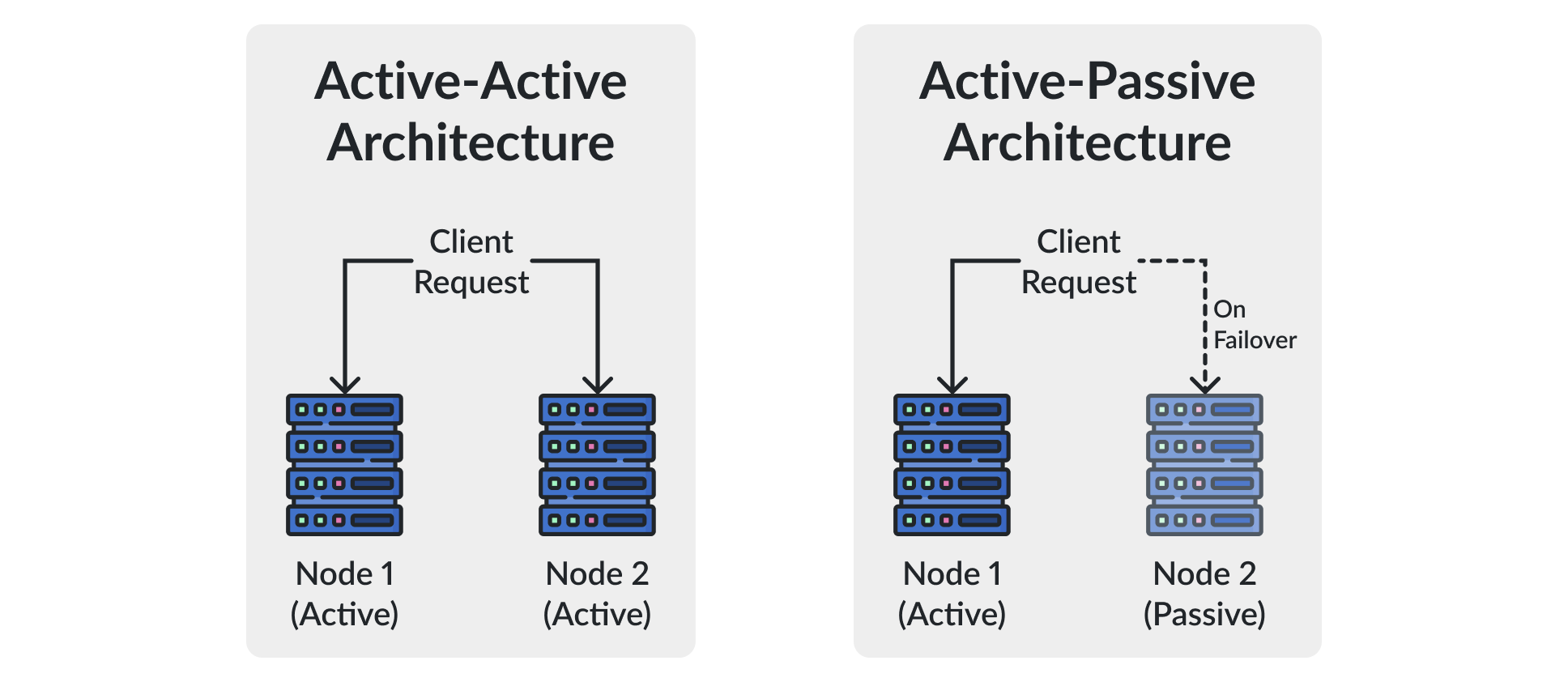
At their core, the two architectures represent different philosophies about how redundancy should work and also depend on physical or network limitations.
In an active-active setup, multiple components operate simultaneously and share the incoming workload. Every component is live, serving traffic. If one node fails, the others absorb its load without any manual intervention or noticeable service disruption.
In an active-passive setup, one node handles all the work while a secondary node sits in standby. The passive node exists purely as insurance – ready to take over if the primary fails, but otherwise idle. You’re paying for capacity you’ll only use in an emergency, which is a real cost that comes up in every budget conversation.
These architectures aren’t mutually exclusive, and honestly that’s something people overlook too often. You can run active-active storage access while building active-passive for disaster recovery. They can coexist at different layers of your stack. This article mostly focuses on storage and clustering subsystem layers, though the principles apply broadly.
Key differences between active-active and active-passive
Resource utilization is the most visible difference. Active-active puts all nodes to work, so your hardware investment is always earning its keep. Active-passive keeps the standby node idle – you’re paying for compute you won’t use unless something breaks.
Failover behavior is where things get interesting. In an active-active system, a node failure is handled automatically and near-instantly. Depending on the system and layer, the switch can take seconds or be imperceptible. Active-passive requires a failover process: detect the failure, promote the standby node, redirect traffic. Even a well-tuned active-passive system introduces some delay, and you’ll likely drop some requests during the transition. Recovery usually takes minutes, not seconds.
Scalability follows the same pattern. Active-active systems scale horizontally – add more nodes, get more capacity and performance. Active-passive scaling is limited by the primary node. The standby doesn’t help with performance during normal operation.
Complexity is where active-passive has a genuine advantage. Because only one node is handling state, there’s no need to synchronize data across multiple live instances. Active-active systems require careful coordination – fast networking, conflict resolution logic, consensus protocols – and all of that introduces engineering complexity and potential failure modes. If you’ve ever debugged a split-brain scenario at 3am (where two nodes both think they’re the primary), you know this complexity isn’t theoretical.
Active-active vs active-passive comparison
Complexity is where active-passive has a genuine advantage. Because only one node is handling state, there’s no need to synchronize data across multiple live instances. Active-active systems require careful coordination – fast networking, conflict resolution logic, consensus protocols – and all of that introduces engineering complexity and potential failure modes. If you’ve ever debugged a split-brain scenario (where two nodes both think they’re the primary), you know this complexity isn’t theoretical.
Side-by-side comparison
| Aspect | Active-active | Active-passive |
|---|---|---|
| Resource usage | All nodes active, fully utilized | Standby node idle |
| Failover speed | Near-instant, automatic | Seconds to minutes, requires failover process |
| Scalability | Horizontal scaling | Limited by primary node |
| Performance | Improves with more nodes | Fixed during normal operation |
| Complexity | High (synchronization, conflict resolution) | Lower (single active node) |
| Cost efficiency | Higher utilization, better ROI | Idle resources until failure |
How active-active architecture works
In an active-active system, a load balancer (either in front of the cluster or embedded in the system) distributes incoming requests across all available nodes. When a node fails, the load balancer detects it and routes traffic to the remaining nodes. From your users’ perspective, the service continues uninterrupted.
Load balancing and traffic distribution
Load balancers use several strategies to distribute requests. Round-robin cycles through nodes sequentially – it’s simple and works well when nodes have comparable capacity. Least-requests routing sends new requests to whichever node currently has the fewest active connections, which works better when requests vary significantly in processing time. Geo-distribution routes users to the nearest node based on geography, reducing latency for globally distributed systems. You’ll often see combinations of these – geo-routing at the DNS layer, then least-requests within a region.
Data consistency and conflict resolution
Here’s where active-active gets genuinely hard. When multiple nodes are simultaneously handling writes, you need a strategy for what happens when two nodes try to modify the same data at the same time. This is the part that looks clean on whiteboards and turns ugly in production.
Synchronous replication ensures every write is confirmed on all nodes before it’s acknowledged to the client. You get strong consistency, but you pay for it in latency – every write is now as slow as your slowest node. This works fine within a datacenter where inter-node latency is sub-millisecond, but it gets painful across regions where you might be looking at 50-200ms round-trip times.
Asynchronous replication is faster for the client but introduces the possibility of conflicts. If two users update the same record on different nodes before replication catches up, you need a conflict resolution strategy. Common approaches include last-writer-wins (simple but can silently lose data), vector clocks (used by systems like DynamoDB), and CRDTs (conflict-free replicated data types, used by Redis Enterprise and Riak). Each has trade-offs, and picking the wrong one for your workload can cause subtle data corruption that’s incredibly hard to debug.
Database-specific implementations vary widely. PostgreSQL’s logical replication can support active-active with tools like BDR (Bi-Directional Replication), but it requires careful schema design to avoid conflicts. MySQL Group Replication offers multi-primary mode, but write-heavy workloads can hit performance walls due to certification-based conflict detection. If you’re running something like Galera Cluster for MySQL, you should know that it uses synchronous replication at the certification layer, which means large transactions can stall the entire cluster.
Split-brain scenarios
The scariest failure mode in active-active is split-brain: a network partition causes nodes to lose contact with each other, and each partition continues operating independently, accepting writes that diverge. When the partition heals, you’re left with two copies of reality that need to be reconciled.
Quorum-based systems (like those using Raft or Paxos consensus) handle this by requiring a majority of nodes to agree before accepting writes. The minority partition stops accepting writes, which means you’ve traded availability for consistency – exactly the CAP theorem trade-off. Systems like etcd, ZooKeeper, and CockroachDB take this approach. Other systems, like Cassandra, prefer availability and use techniques like hinted handoff and read repair to eventually converge after a partition. You need to understand which trade-off your system makes before you’re in the middle of an incident.
How active-passive architecture works
Active-passive is simpler by design. One node handles the entire workload. The secondary node continuously monitors the primary – usually through a heartbeat mechanism – but doesn’t serve any traffic. When the primary fails, the standby takes over.
Failover process
The failover process has three stages. First, failure detection: the monitoring system identifies that the primary node has stopped responding. Detection time depends on your heartbeat interval and timeout settings – set them too aggressive and you’ll get false positives that trigger unnecessary failovers, set them too conservative and you’ll have longer outages. Finding the right balance is harder than it sounds, and it’s worth testing extensively before you need it.
Second, standby promotion: the passive node transitions to an active state. Depending on the system, this might be fully automated or require manual intervention. In database clusters, this step often involves replaying transaction logs to ensure the standby is fully caught up.
Third, traffic redirection: DNS records, load balancer configuration, or network routing is updated to point traffic to the newly promoted node. If you’re relying on DNS-based failover, remember that TTL values matter – clients caching the old DNS record will keep trying to reach the dead node until their cache expires.
The entire process can take anywhere from a few seconds to several minutes. During that window, your service is unavailable. If you haven’t tested your failover recently, that window might be a lot longer than you think.
Active-active storage with StarWind Virtual SAN
High availability is not just a concern at the application layer, storage infrastructure needs the same resilience. StarWind Virtual SAN (VSAN) is a software-defined storage solution that implements active-active architecture at the storage layer, giving organizations a concrete way to eliminate storage as a single point of failure.
StarWind aggregates local storage from multiple nodes and presents it as shared storage to hypervisors and virtual machines. Data is mirrored between nodes using synchronous replication, meaning every write is confirmed on both nodes before it is acknowledged. Both nodes serve I/O requests simultaneously, which is what makes this genuinely active-active rather than active-passive with a warm standby.
Active-active storage with StarWind Virtual SAN
Storage infrastructure needs the same resilience as your application layer. StarWind Virtual SAN (VSAN) is a software-defined storage solution that implements active-active architecture at the storage layer.
StarWind aggregates local storage from multiple nodes and presents it as shared storage to hypervisors and VMs. Data is mirrored between nodes using synchronous replication – every write is confirmed on both nodes before it’s acknowledged. Both nodes serve I/O requests simultaneously, which is what makes it genuinely active-active rather than active-passive with a warm standby.
How StarWind implements active-active
StarWind uses synchronous two-way (or three-way) replication between nodes, so both always hold an identical copy of the data. Storage is presented over iSCSI or NVMe-oF, making it accessible to hypervisors including Hyper-V, VMware ESXi, Proxmox VE (and other KVM implementations) without specialized hardware.
Because both nodes are always active, read and write operations are distributed across the nodes. Write operations are synchronized in real time, and read throughput improves drammatically compared to single-controller designs. There’s a trade-off worth knowing about: synchronous replication means write latency is bounded by the slower node and the network between them. For nodes within the same datacenter this is negligible, but if you’re thinking about stretching this across sites with meaningful network latency, you’ll feel it.
StarWind vs traditional active-passive storage
Some traditional SAN and NAS solutions rely on active-passive replication. One storage controller handles all I/O and replicates to a passive controller on a schedule. The passive controller waits in reserve, contributing nothing to performance during normal operation. StarWind’s model has both nodes active, both serving I/O, and failover is almost transparent (taking just a couple of seconds for VMs and containers to restart after failover) because the secondary node is already synchronized and operational.
Role in HA architecture
StarWind operates at the storage layer, providing the foundation on which other HA components depend. It integrates with Hyper-V Failover Clustering, VMware vSphere HA, and KVM-based clusters, so you can build end-to-end HA where both compute and storage are resilient without dedicated storage hardware.
Other options worth knowing about
If you’re looking for a storage engine with advanced features that supports both active-active and active-passive approaches, check out DataCore SANsymphony. Running Kubernetes clusters and want active-active HA for stateful pods? Look at DataCore Puls8.
Benefits of active-active vs active-passive
Each architecture has a distinct set of strengths, and the right choice depends on what you are optimizing for.
Active-active offers high scalability, since additional nodes usually increase performance and sometimes capacity. Performance is better because workloads are distributed across multiple live nodes rather than funneled through a single primary. And because all nodes are in use, you get full utilization from your hardware investment. There is no idle standby capacity draining your budget without contributing to throughput.
Active-passive is simpler to design, configure, and understand. With only one node handling state at any given time, troubleshooting is more straightforward. There is no need to reconcile conflicting states across multiple live nodes. Failover behavior is also more predictable, which matters in environments where change control is strict and auditability is important.
Use cases for each architecture
Different workloads and environments favor different approaches. Choosing between active-active vs active-passive depends on whether you prioritize performance, scalability, or operational simplicity.
Active-active is the right choice when performance, scale, and minimal downtime are the priorities. SaaS platforms that serve users continuously and cannot tolerate perceptible outages benefit from active-active’s near-zero failover. High-traffic web applications where load spikes are common need the horizontal scalability that active-active enables. Distributed cloud systems spanning multiple regions are almost always designed with active-active principles to ensure availability even when an entire region goes down.
Active-passive fits scenarios where simplicity of recovery matters more than raw performance or in DR scenarios. Disaster recovery environments often use active-passive because the passive site only needs to be activated during a genuine crisis. Legacy workloads that were not designed with distributed operation in mind may not support active-active without significant re-architecture.
Challenges and limitations
The biggest challenge with active-active is the synchronization problem. When multiple nodes are simultaneously handling state, you need coordination logic to keep them consistent. Data synchronization is particularly painful for write-heavy workloads, where conflicts between nodes have to be detected and resolved. CRDTs (conflict-free replicated data types) help in some cases, but they’re not a universal solution – they work well for counters and sets, less well for arbitrary application state. Building and operating active-active requires more engineering investment upfront, and the operational complexity doesn’t go away after deployment. You’re signing up for ongoing work.
Split-brain scenarios deserve special mention. If the network link between active-active nodes fails, both nodes might continue operating independently, accepting conflicting writes. When connectivity is restored, you’ve got a reconciliation problem. Quorum-based systems (requiring a majority of nodes to agree before accepting writes) mitigate this, but they introduce their own trade-offs around write availability.
Active-passive’s core limitation is that you’re paying for hardware that sits idle most of the time. Depending on your infrastructure, that standby node might represent 30-50% of your storage costs with zero contribution to daily throughput. Failover is also slower – even well-tuned systems introduce a gap where requests are dropped. And there’s a more subtle issue: the standby node can drift from the primary in terms of patches, configuration, or even firmware versions if you’re not disciplined about keeping them synchronized. When failover actually happens, you don’t want to discover that the standby is running a different kernel version.
Choosing the right model
Here’s a concrete decision framework rather than another “it depends.”
If your RTO is under 30 seconds, you’re serving more than 10,000 concurrent users, and your workload can tolerate the complexity of distributed state management – go active-active. If your team has experience operating distributed systems and you have the budget to maintain all nodes as production infrastructure, it’ll give you better resource utilization and faster failover.
If your RTO is measured in minutes rather than seconds, your workload is stateful in ways that don’t lend themselves to distribution, or your operations team is small – active-passive is the pragmatic choice. It’s not a lesser architecture, but a simpler one, and simplicity has real operational value.
The best approach for most organizations is to combine both. Run active-active for your primary virtualization layer where performance and availability matter most, and use active-passive for DR where the standby site only needs to activate during a genuine crisis. Don’t limit yourself to one model across your entire infrastructure – apply each where it makes sense.
Your RPO (recovery point objective) matters here too. Active-active with synchronous replication gives you near-zero RPO – no data loss on failover. Active-passive with asynchronous replication means you could lose the data written between the last replication cycle and the failure. If that window is 15 minutes and your application writes critical financial transactions, that’s a problem you need to account for.
Conclusion
If you take one thing from this article, it’s that active-active and active-passive aren’t competing philosophies – they’re tools for different problems, and most production environments should use both. The real risk isn’t choosing the wrong one, but deploying either without properly testing it. Run your failover tests. Verify your standby nodes are actually current. Check that your synchronization is working smoothly even during high load. The architecture you’ve designed on paper is only as good as the last time you proved it works under real failure conditions.