Why Is 3-Way Synchronous Mirroring Better Than 2-Way?
- August 07, 2012
- 3 min read


1. Cost-efficiency
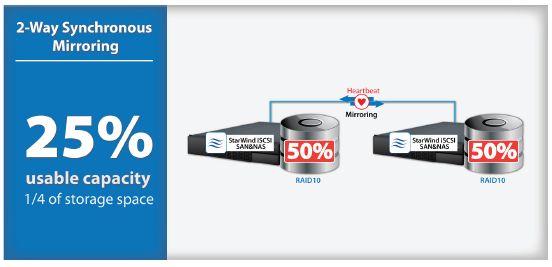
2-way synchronous mirroring
This configuration requires storage redundancy on the nodes. The use of RAID10* is recommended. 2-node HA ensures the synchronous mirroring of data between two storage nodes. Taking into account that each storage node only has 50% usable capacity with RAID10, synchronous mirroring makes the further dividing of those 50% by half resulting in the underutilization of storage capacity – only 25% is used.
* RAID5, RAID6 can also be used. However, it is not recommended because of the high probability of disk failure while rebuilding RAID5, and the low write performance of RAID6.
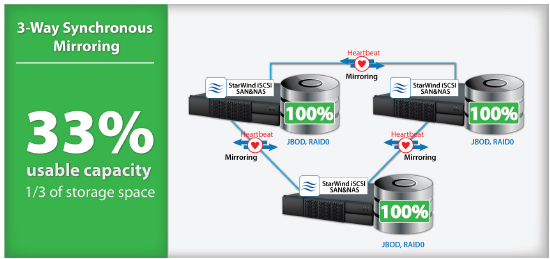
3-way synchronous mirroring
This configuration does not require storage redundancy on nodes since 3-way synchronous mirroring already ensures the required level of data protection. Therefore, you can use either JBOD, or RAID0 for performance. Synchronous mirroring between 3 storage nodes results in 33% usable capacity and thus provides a higher level of utilization compared to 2-way synchronous mirroring.
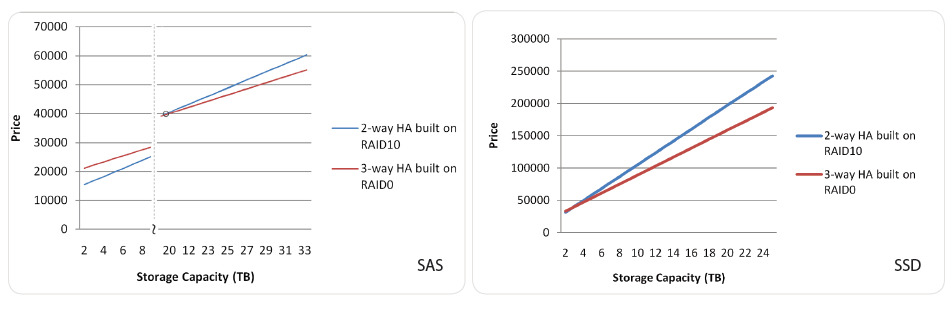
As a result, 3-way synchronous mirroring accelerates ROI and increases the storage utilization rate. The cost-efficiency of this configuration differs depending on the medium type – spindle or flash. The difference is shown on the charts below.
2. Increased reliability
3. Higher performance
MPIO paths
2-way synchronous mirroring
With Round Robin policy used, I/Os are processed up to two times faster comparing to a single-node configuration.
3-way synchronous mirroring
Owing to the Round Robin policy, the I/Os throughput rises by a factor of 3 compared to singlenode storage.
As a result, performance is increased by up to 50% compared to a 2-node configuration.
RAID10* vs RAID0 and JBOD
2-way synchronous mirroring
This configuration strongly requires extra redundancy for data protection on the storage nodes themselves. This redundancy can be provided through the use of RAID. RAID10 is recommended as it ensures mirroring between the disk stripes and makes fast reads and writes. However, storage utilization is considerably low because the same data is mirrored and stored on two stripes of RAID.
* Use of RAID5, RAID6 is possible but not recommended because of the high probability of a disk failure while rebuilding RAID5, and the low write performance of RAID6.
3-way synchronous mirroring
No extra redundancy is required on the node because of the existing redundancy. Therefore, RAID0 or JBOD can be used for performance. Both reads and writes are faster here as the system reads the data from all disks simultaneously.