StarWind x Veeam Hardened Backup Repository: Configuration Guide for Bare-metal Installation, StarWind x Veeam Hardened Backup Repository Deployed as a Linux ISO using GUI
- February 27, 2025
- 12 min read
- Download as PDF
Annotation
Relevant products
StarWind x Veeam Hardened Backup Repository (StarWind x VHBR)
Purpose
StarWind x Veeam Hardened Backup Repository (StarWind x VHBR) is a free software that allows to enhance your backups protection against ransomware by easily turning your existing physical server into a Linux Hardened Repository for use with Veeam Backup & Replication.
This document outlines how to configure StarWind x Veeam Hardened Backup Repository on a physical bare-metal server using the StarWind Appliance ISO and includes steps on how to configure it with Veeam Backup & Replication.
Audience
This technical guide is intended for storage and virtualization architects, system and backup administrators designing backup solutions using Veeam Hardened Linux Repository.
Expected result
The end result of following this guide will be a fully configured StarWind x Veeam Hardened Backup Repository (StarWind x VHBR) on a bare-metal server and added to Veeam Backup & Replication.
Prerequisites
StarWind x Veeam Hardened Backup Repository (StarWind x VHBR) system requirements
Prior to installing StarWind x Veeam Hardened Backup Repository (StarWind x VHBR), please make sure that the system meets the requirements, which are available via the following link: https://www.starwindsoftware.com/system-requirements#svhbr
Recommended RAID settings for HDD and SSD disks: https://knowledgebase.starwindsoftware.com/guidance/recommended-raid-settings-for-hdd-and-ssd-disks/
Solution diagram
The diagrams below illustrate the network and storage configuration of the solution:
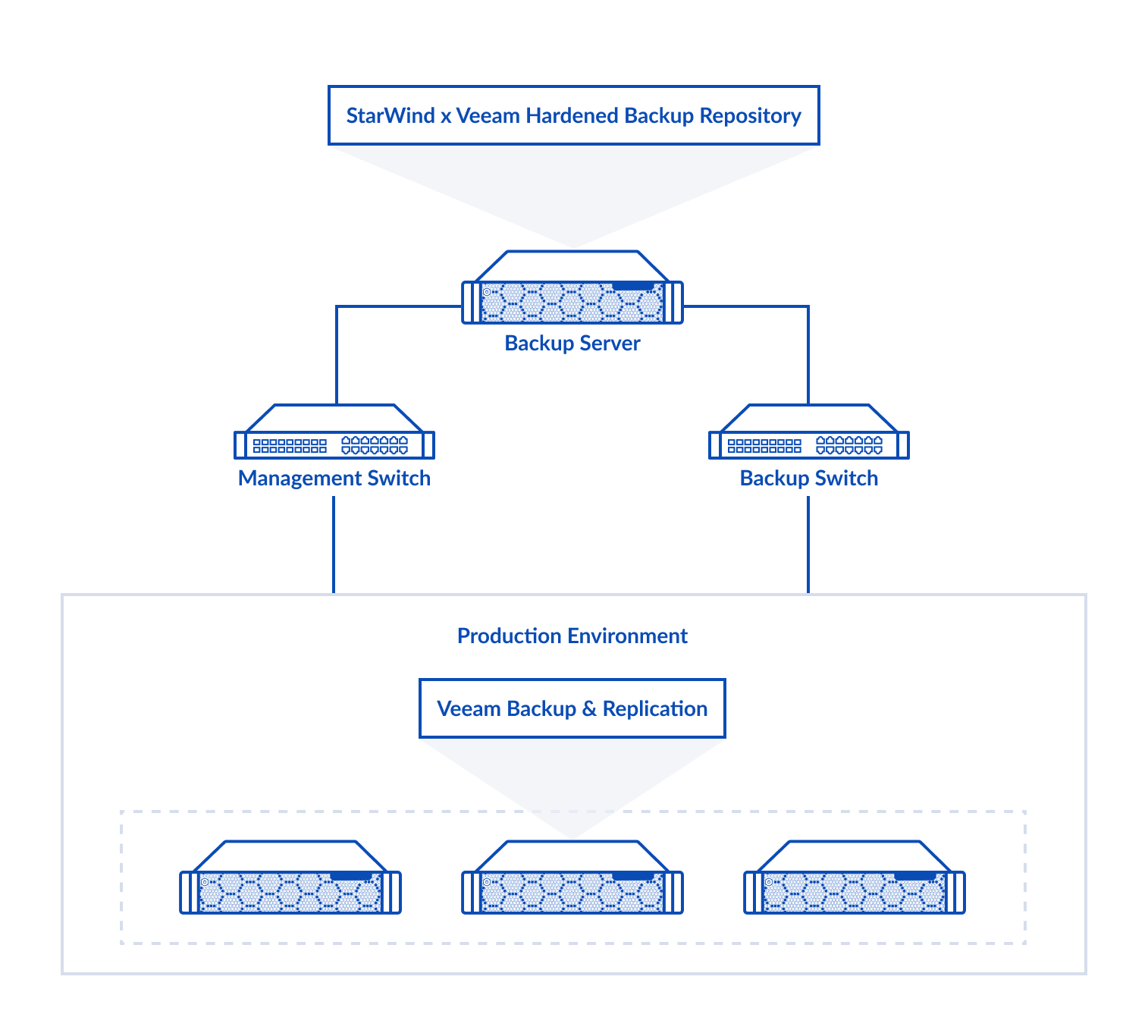
Deploying StarWind x Veeam Hardened Backup Repository (StarWind x VHBR)
1. Download the StarWind x Veeam Hardened Backup Repository archive at the following link and extract the ISO file: https://www.starwindsoftware.com/resource-library/veeam-hardened-backup-repository/#download
2. Prepare installation media using Etcher, Rufus on Windows workstation, or dd command-line tool on Linux and macOS. For Network boot, mount the ISO to your server using iDRAC, iLo, or IPMI user interfaces.
3. Connect the installation media to your server and start the host.
4. Boot into BIOS and enable the Legacy boot mode. Save changes and reboot the host.
5. On server boot, press F12 or F2 to start the one-time boot menu. Select CD\DVD-ROM as a boot device.
NOTE: Refer to the server documentation to find the boot menu key.
6. The server should start booting from StarWind Appliance ISO. Once the system boots, the StarWind Appliance Installer launches.
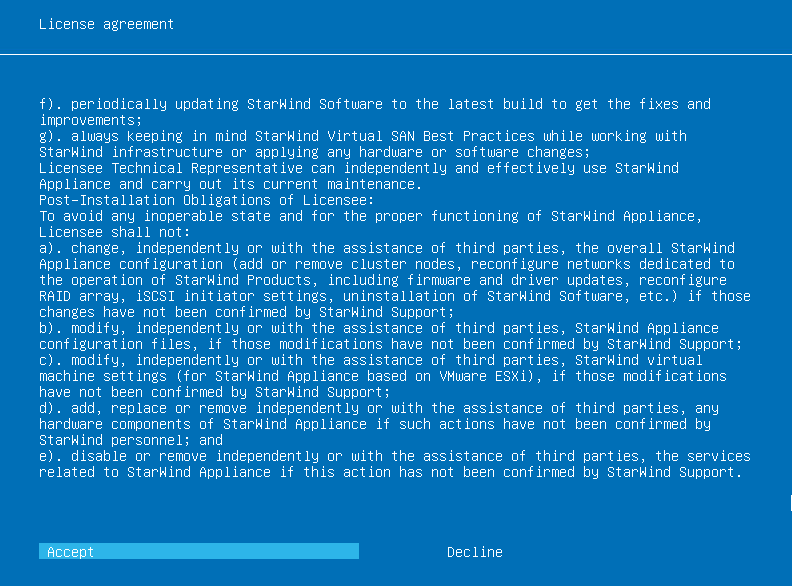
7. Read the End-user License Agreement. Use the Tab button and arrow keys to select the Accept option by pressing Enter.
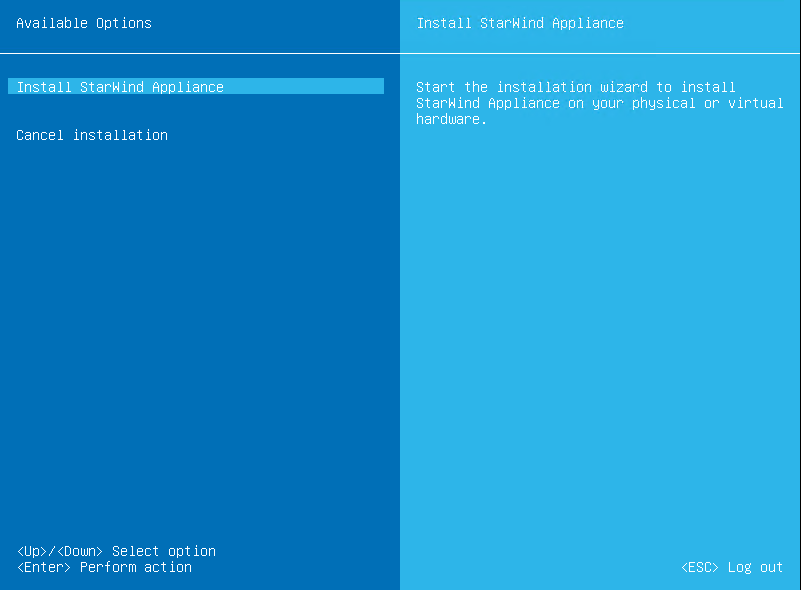
8. In the menu, select the “Install StarWind Appliance” option and press Enter.
9. Select one of the available disks on which to install StarWind Appliance. Press Enter.
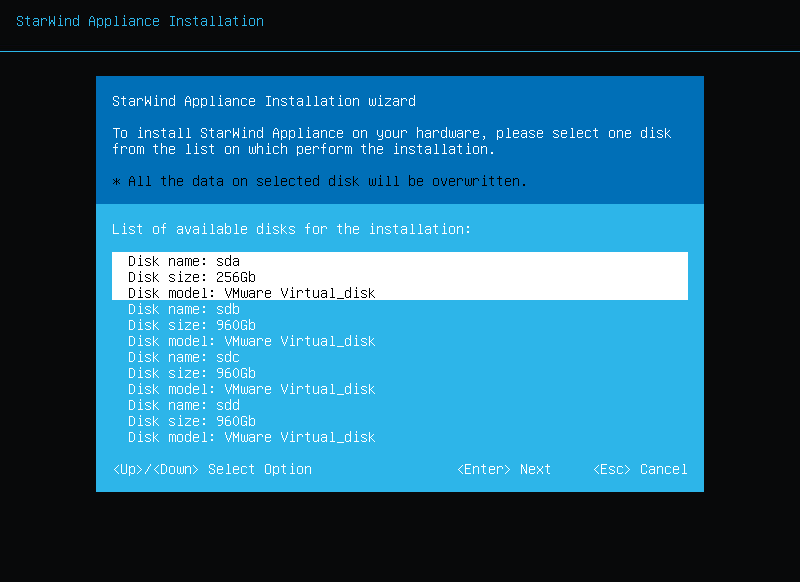
10. All the data on the selected disk will be overwritten. Confirm the installation by typing “yes” and pressing Enter.
11. Wait until the installation is complete.
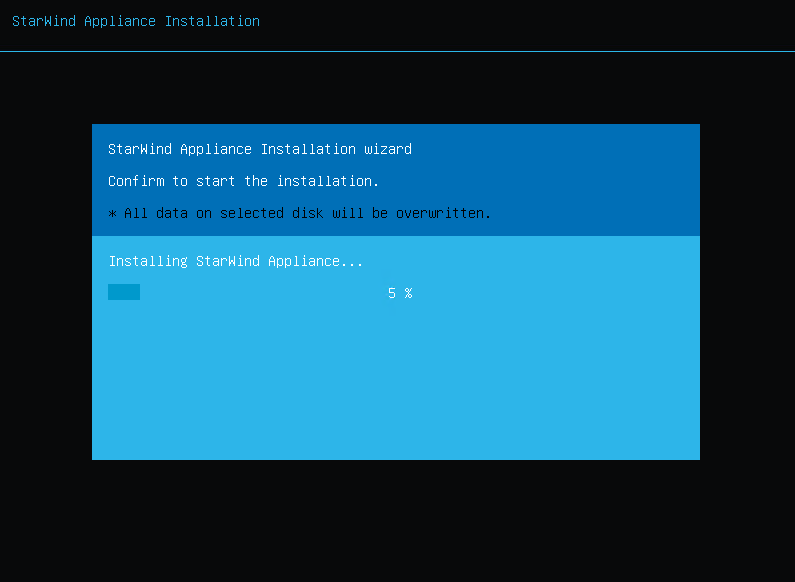
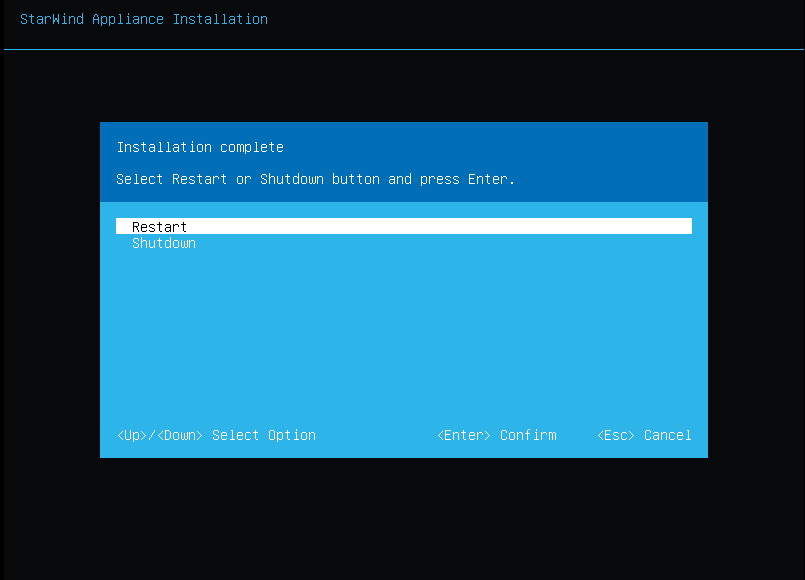
12. The installation is finished. Select “Restart” to reboot the server.
13. Eject the installation media.
14. The server now boots StarWind Appliance.
15. Press Enter to open the console.
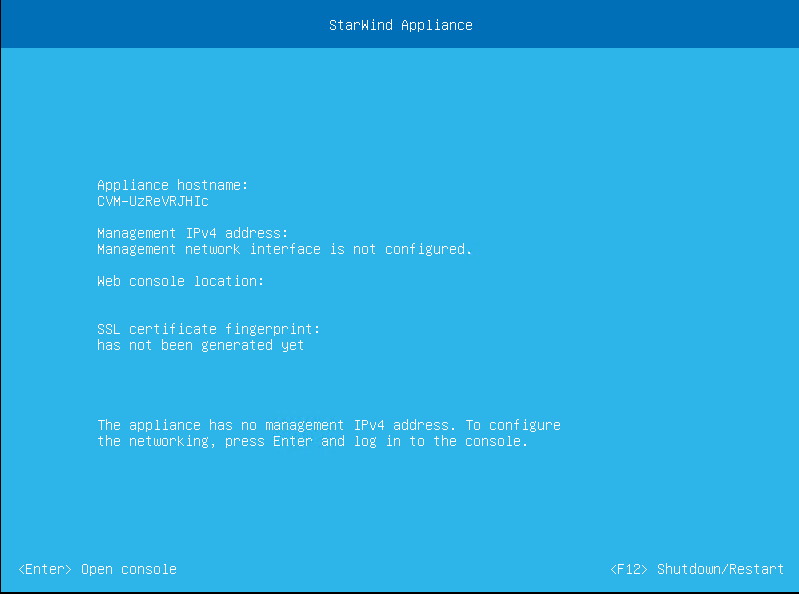
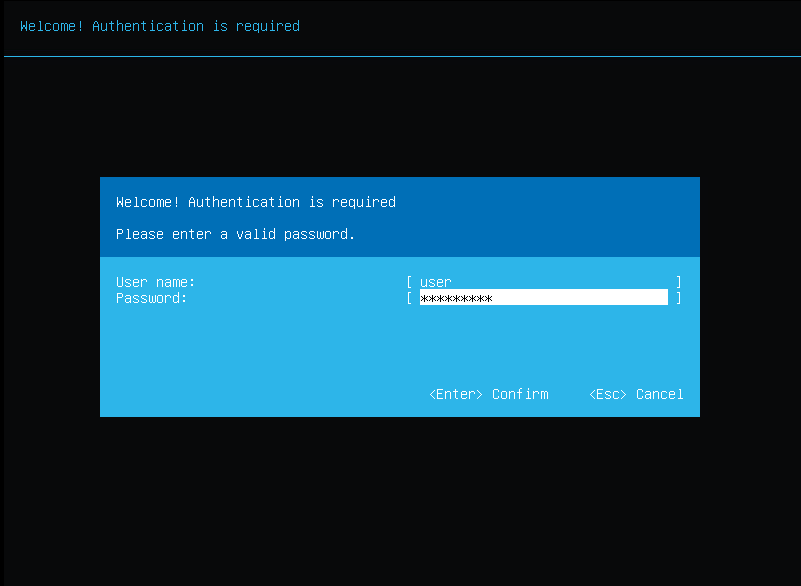
16. Specify the default user name and password.
NOTE: The default account name is “user” and its password is “rds123RDS” without quotes. This account is removed from the appliance upon the completion of the Initial configuration wizard.
17. Select “Configure Management Network” and press Enter.
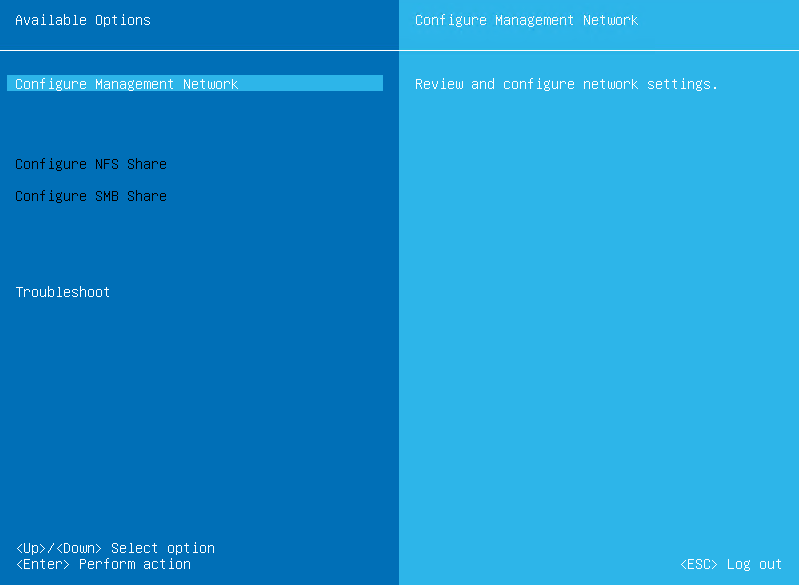
18. Press Enter once more to modify the settings.
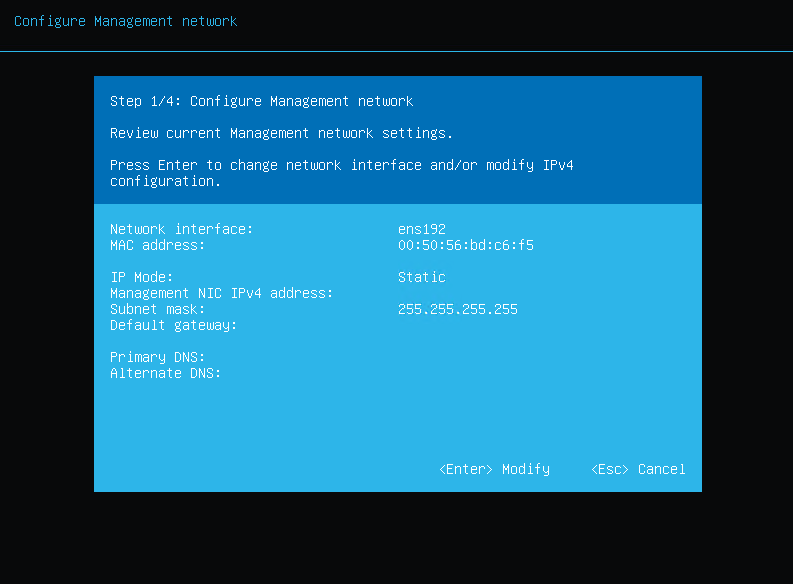
19. Select the network adapter that will be used for management connectivity and press Enter.
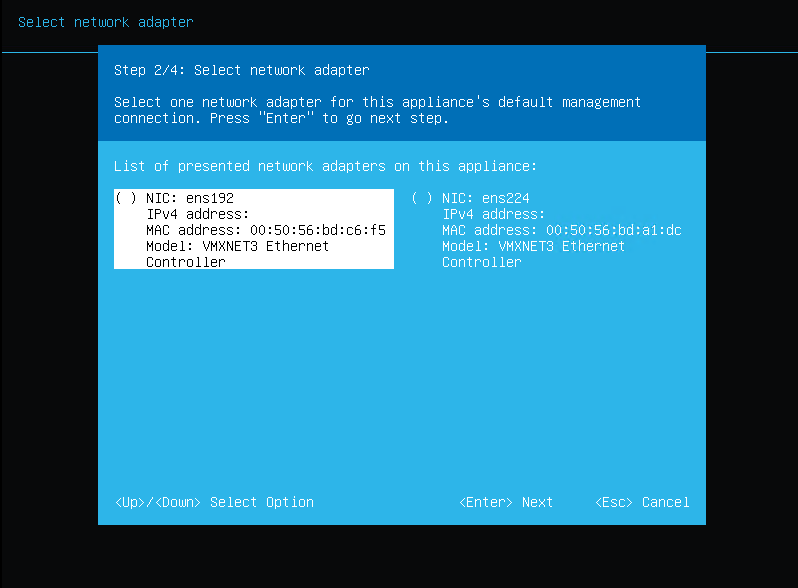
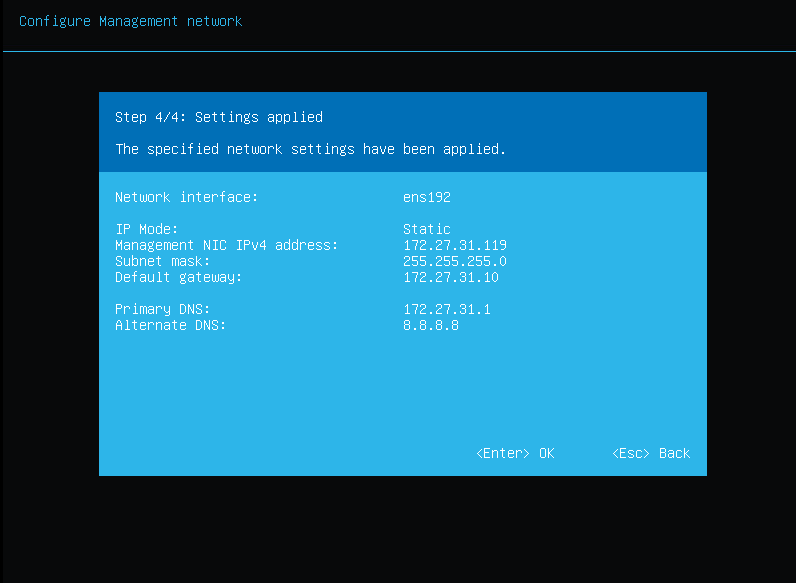
20. Specify the static IPv4 address, subnet mask, default gateway and DNS addresses. Press Enter.
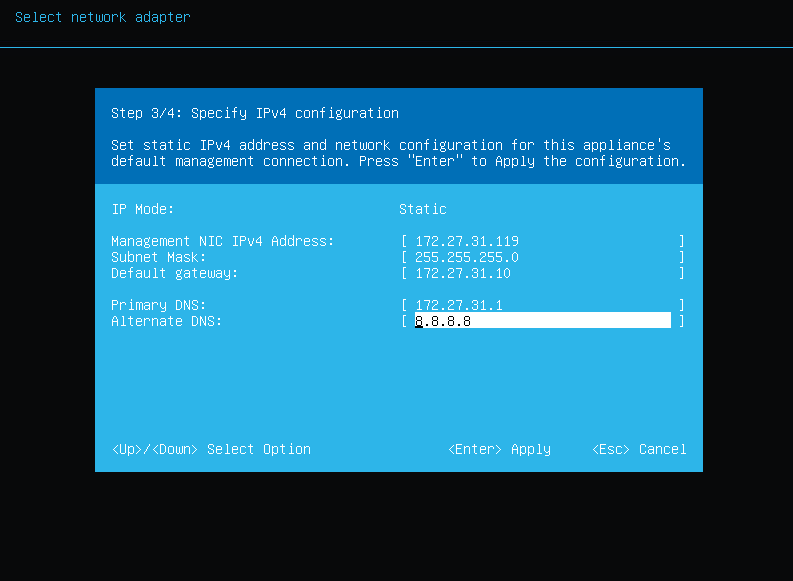
21. The management network settings have been applied. Press Enter.
Initial Configuration Wizard
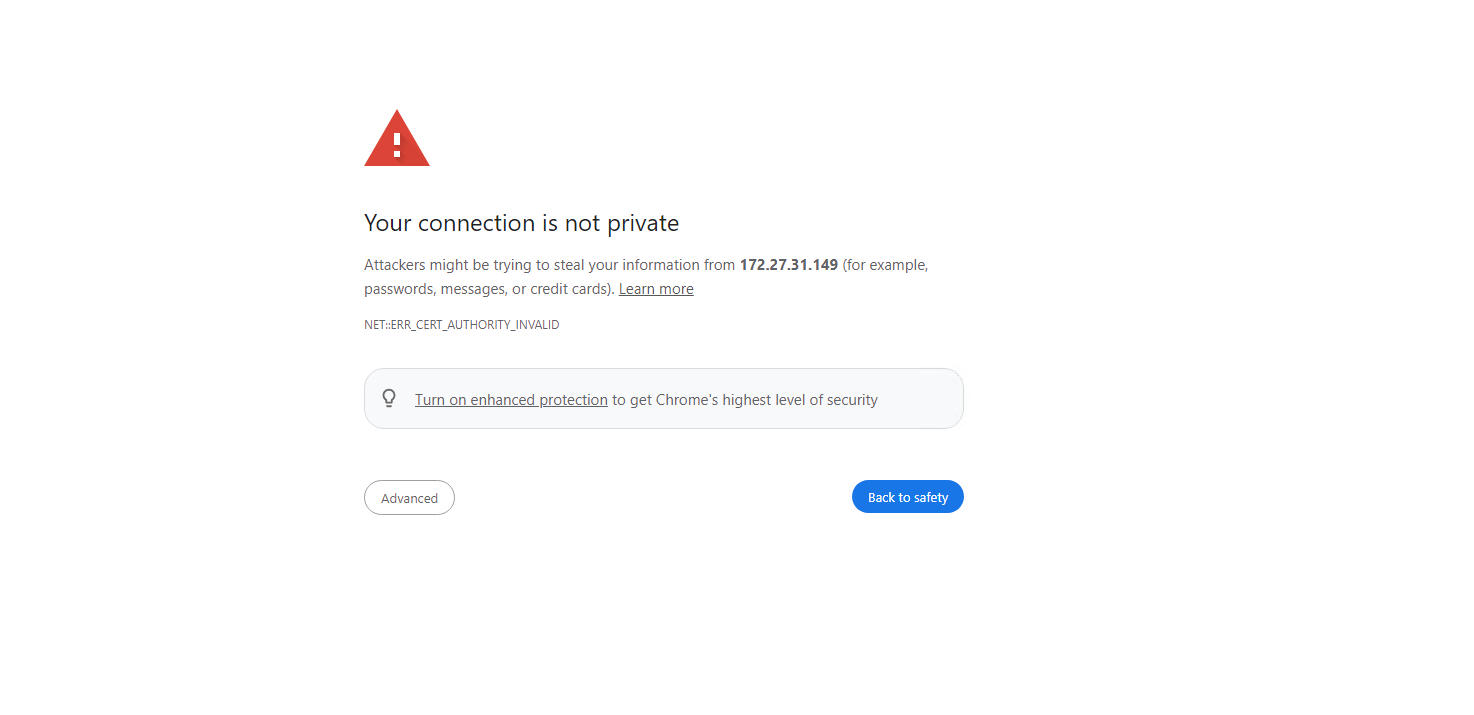
1. Using the web browser, open a new tab and enter the StarWind Appliance IPv4 address specified previously to open the Web Interface. Click “Advanced” and then “Continue to…”
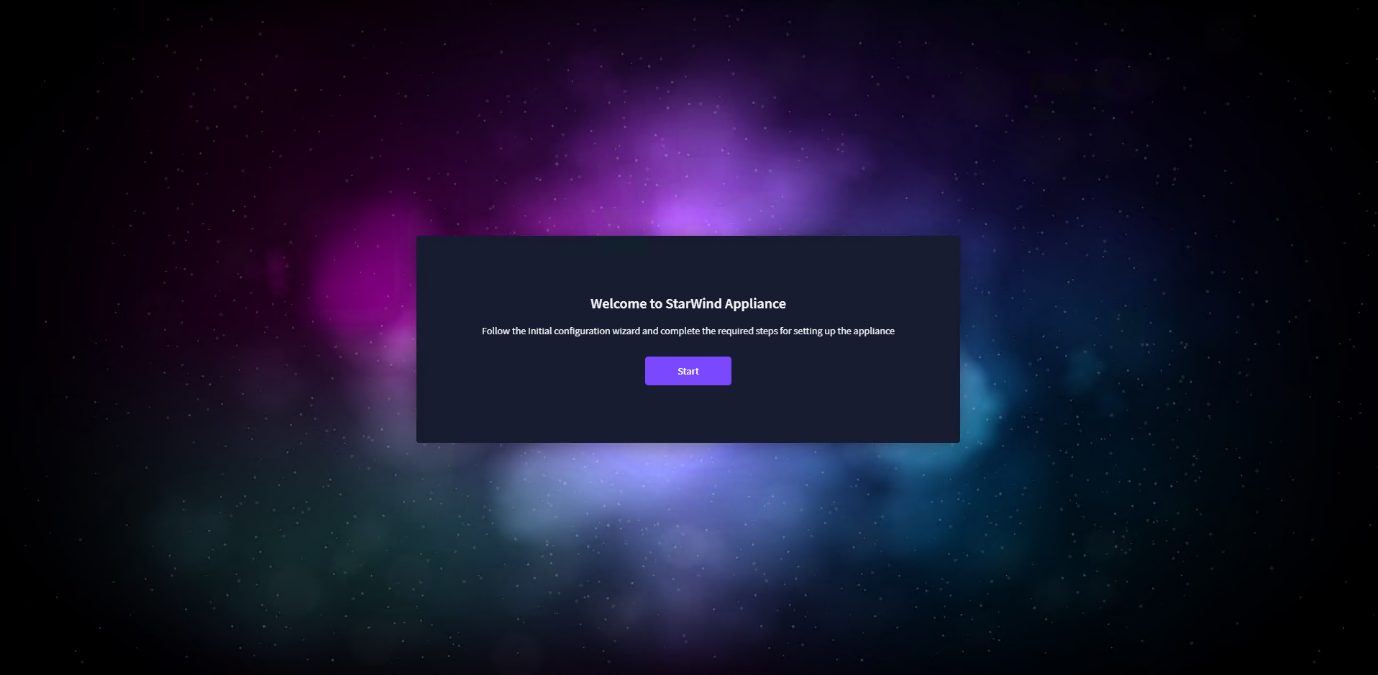
2. StarWind x Veeam Hardened Backup Repository welcomes you, and the “Initial configuration” wizard will guide you through the deployment process. Click Start.
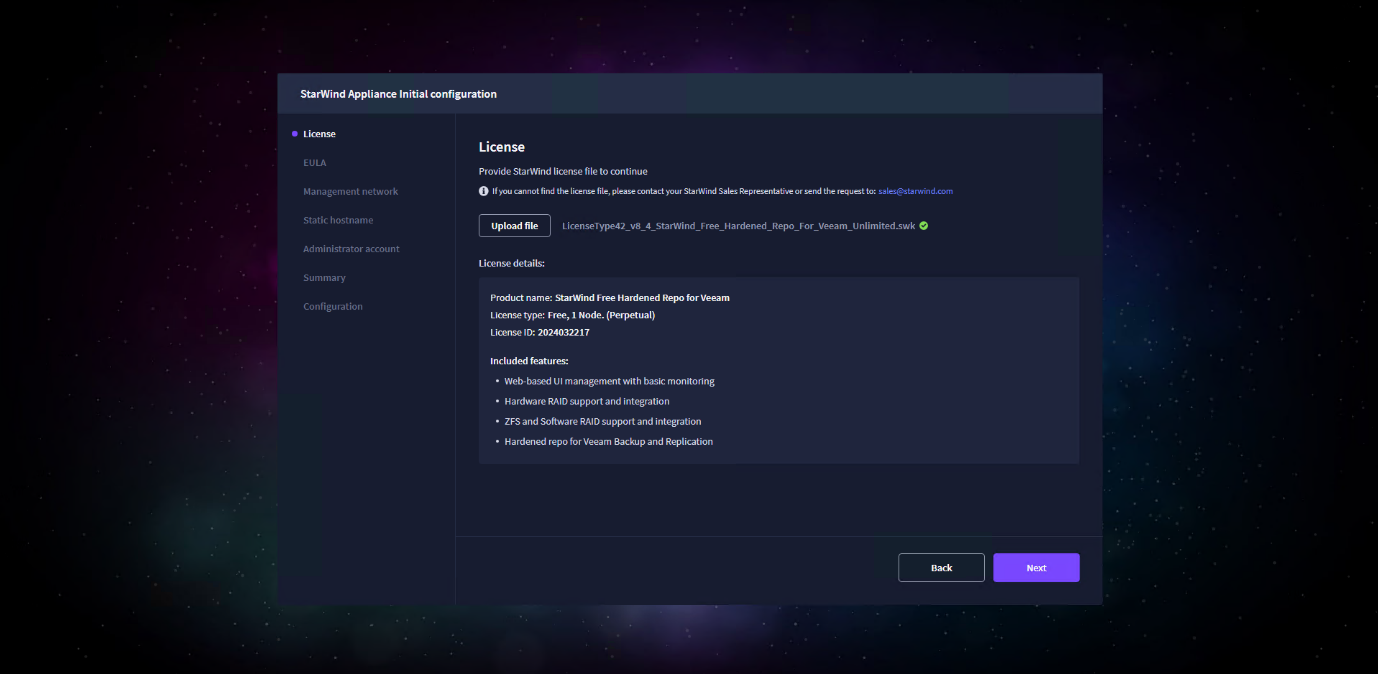
3. Upload the license file and click Next.
4. Read and accept the End User License Agreement to proceed. Click Next.
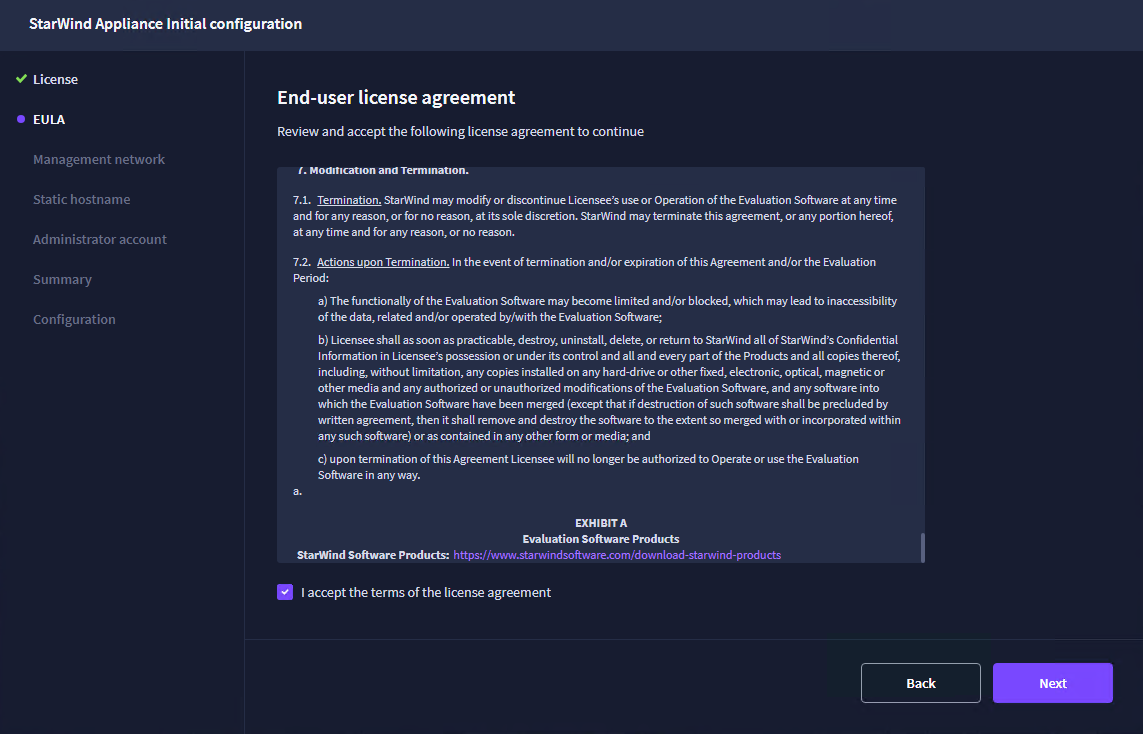
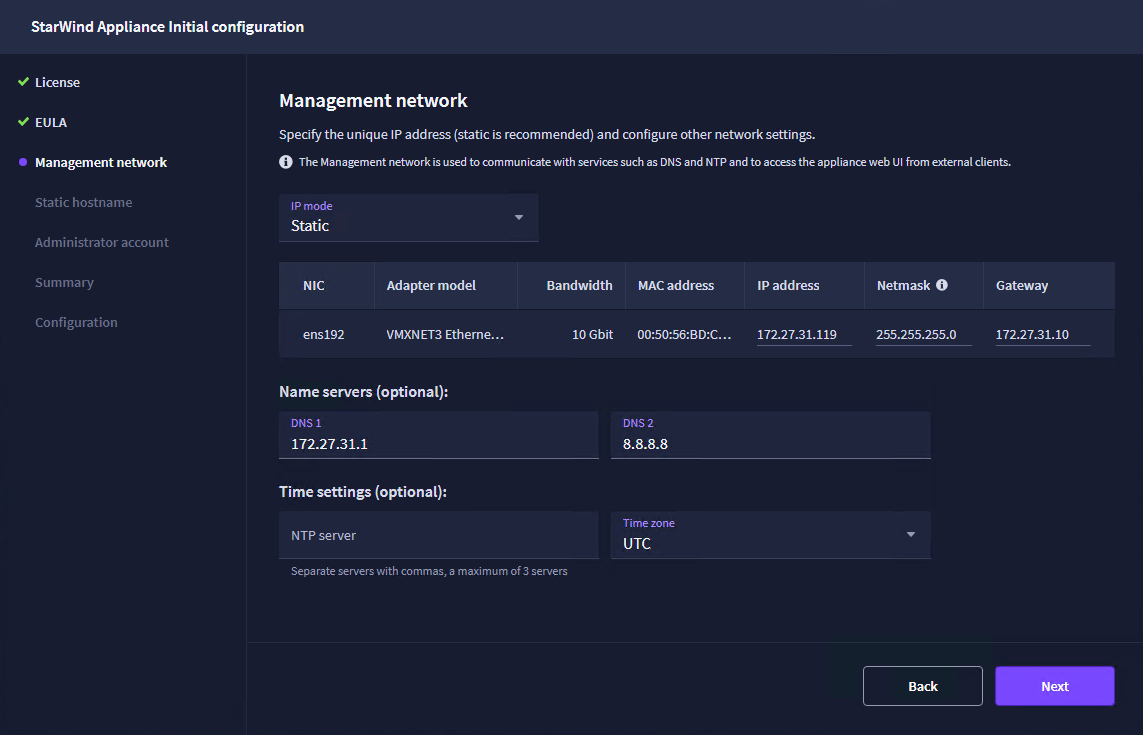
5. Review or edit the Network settings and click Next.
NOTE: Static network settings are recommended for the configuration.
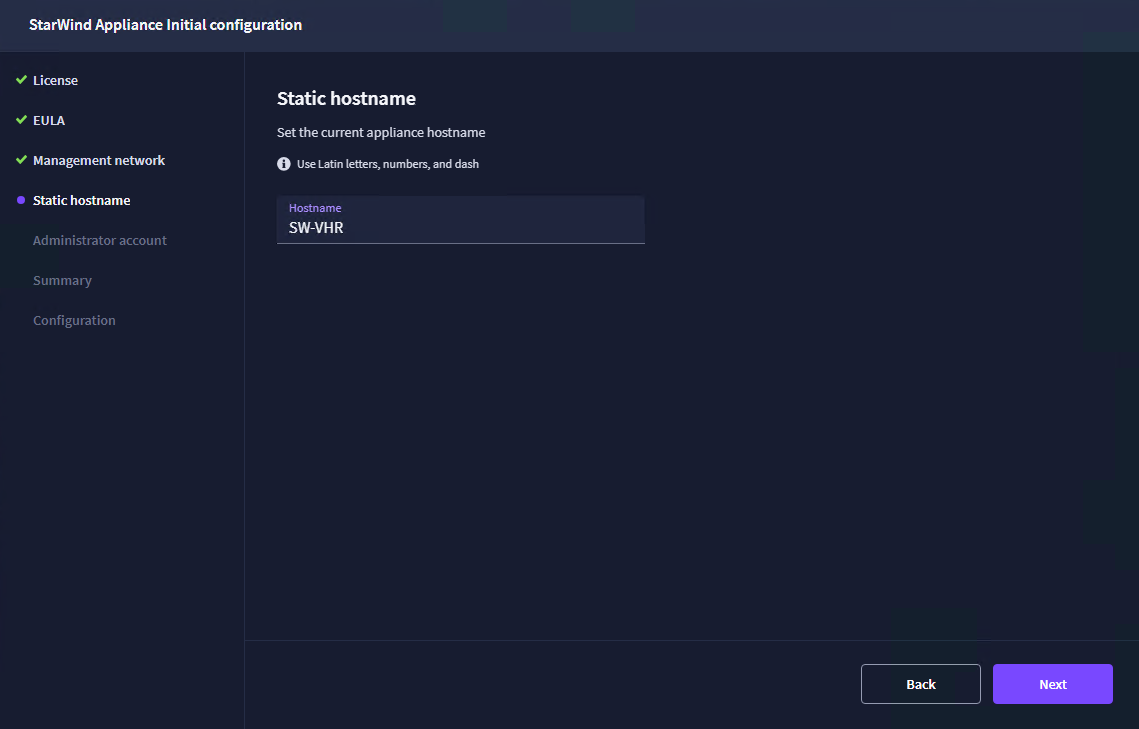
6. Specify the hostname for the StarWind x Veeam Hardened Backup Repository and click Next.
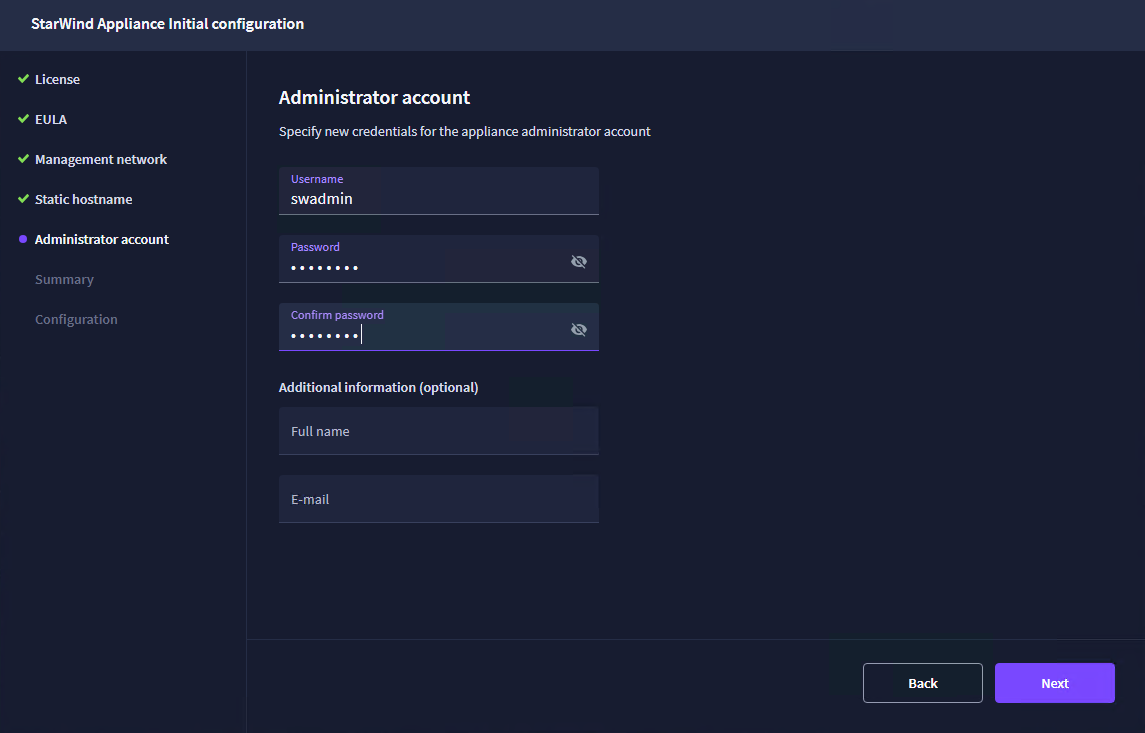
7. Create an administrator account. Click Next.
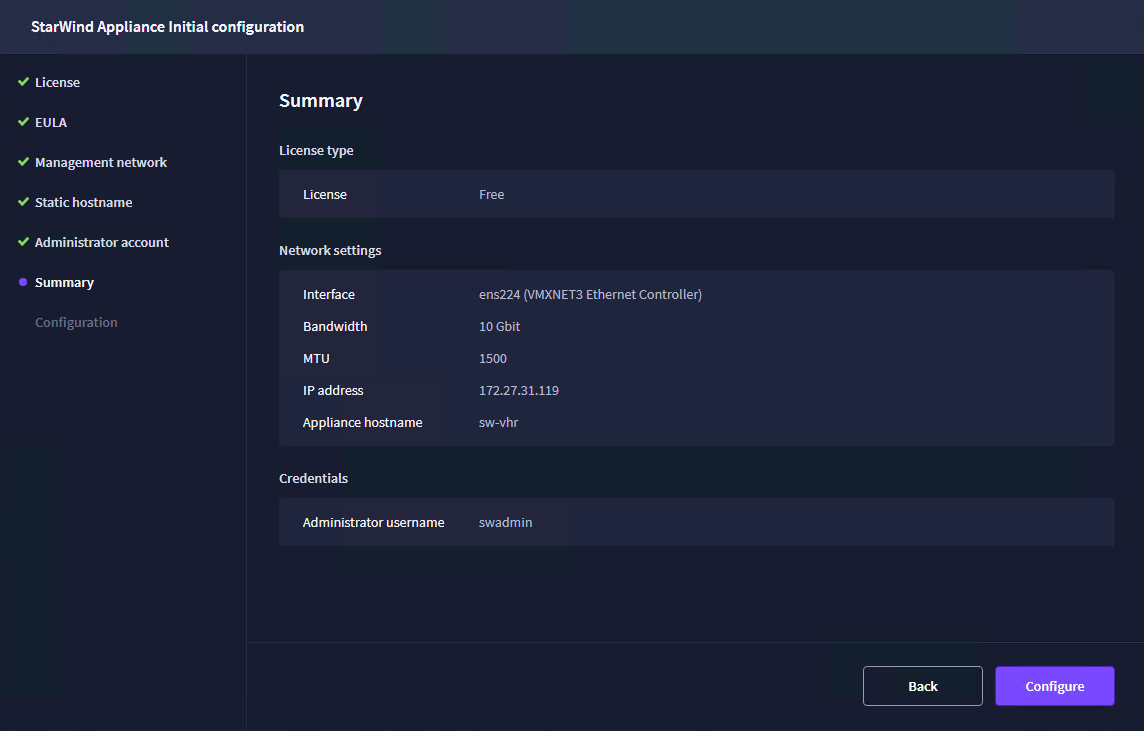
8. Review the settings and click Configure.
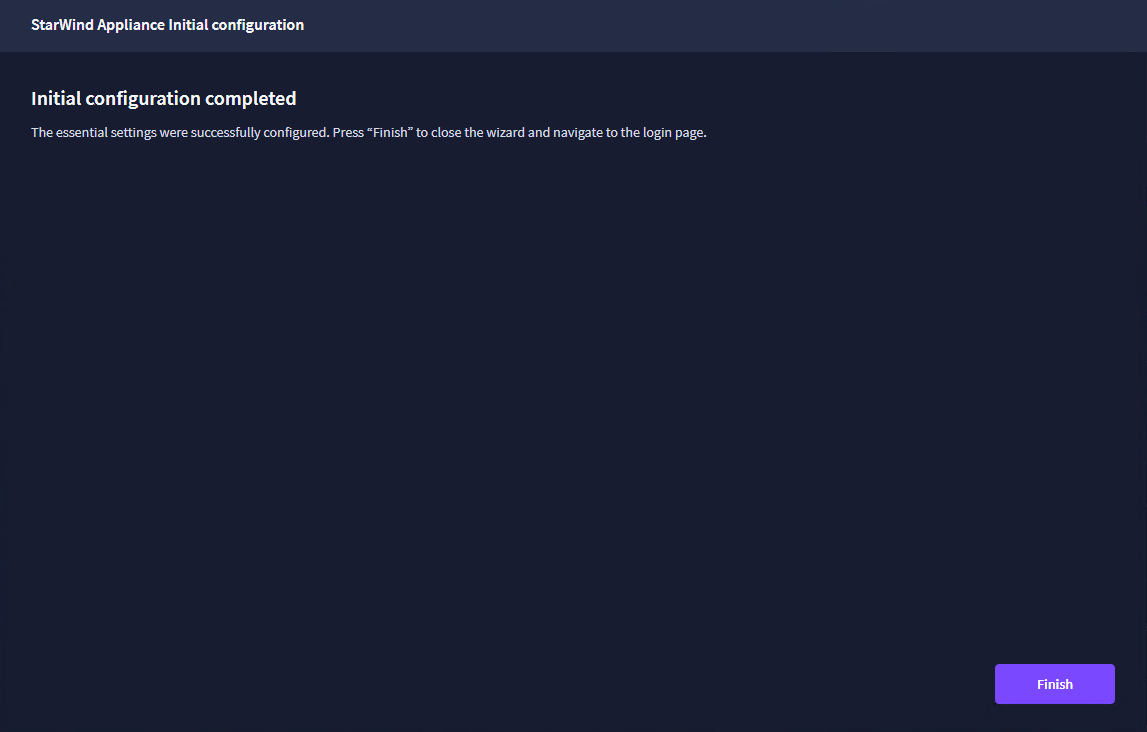
9. The initial StarWind x Veeam Hardened Backup Repository configuration is now complete. Click Finish.
Configure networking
1. Log in to the StarWind x Veeam Hardened Backup Repository using the username and password specified during the initial configuration.

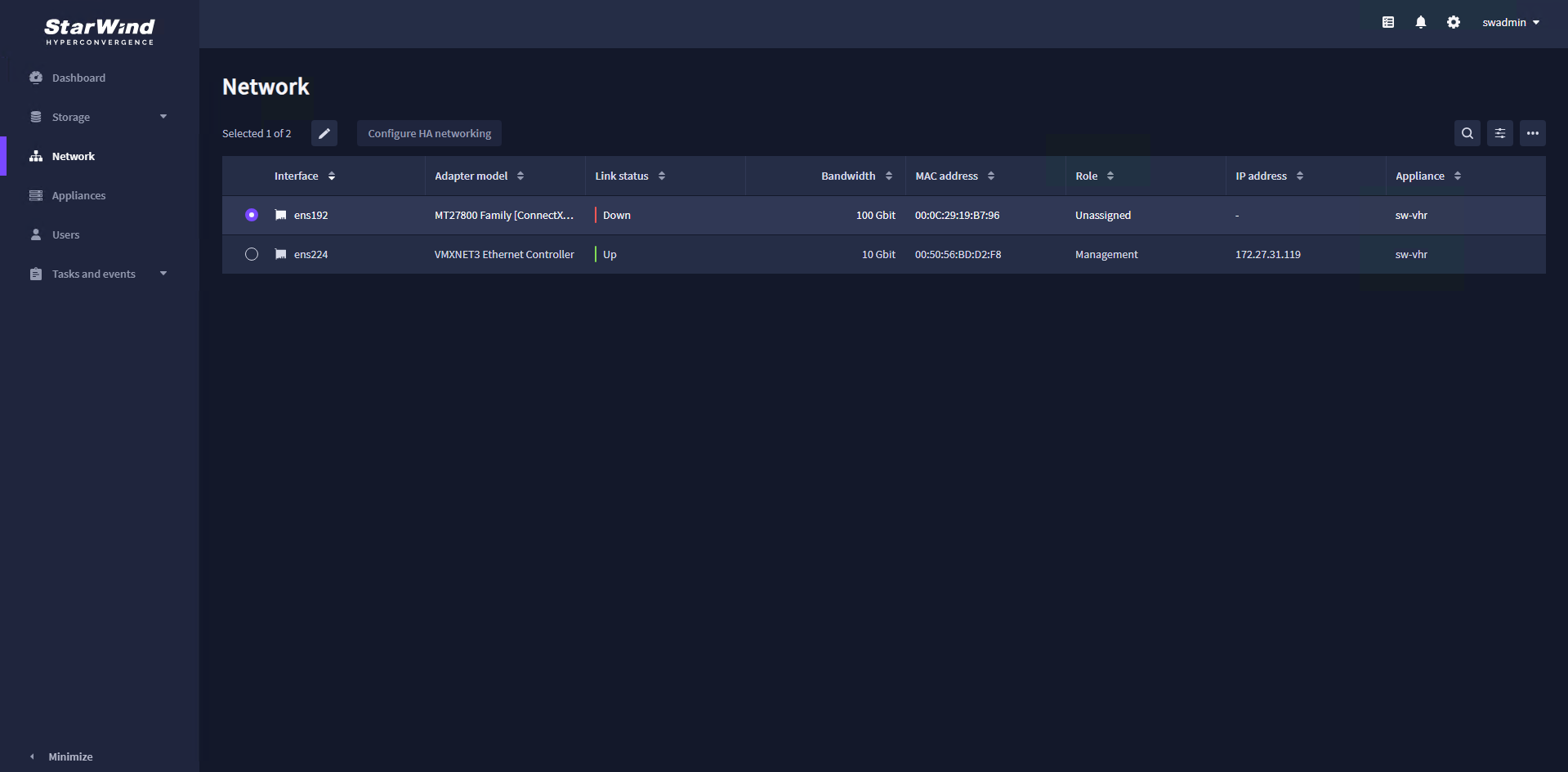
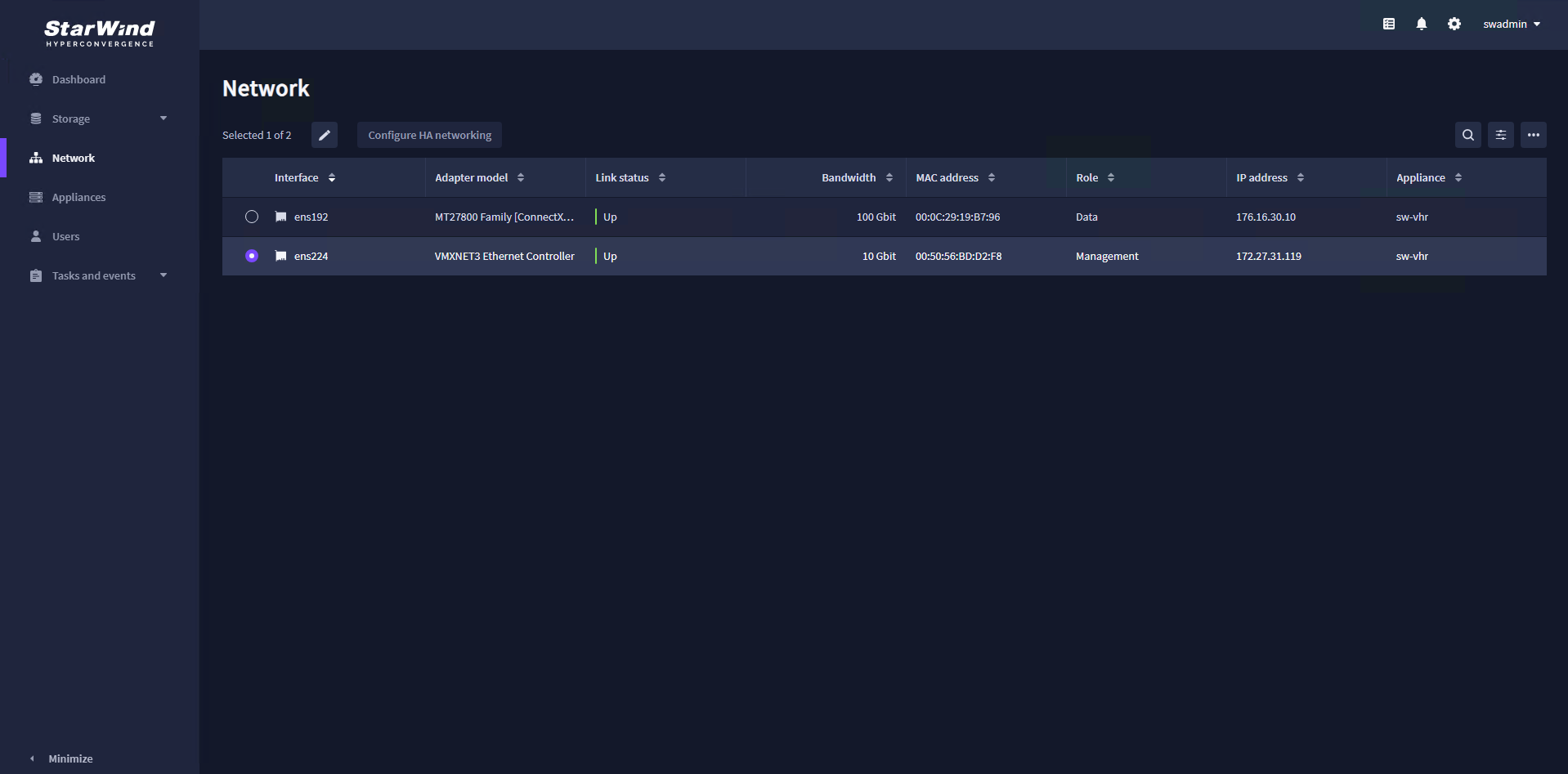
2. Navigate to the Network tab, select the network adapter that will be used for backup (Data) traffic in case a separate dedicated backup network is present and click the Edit icon.
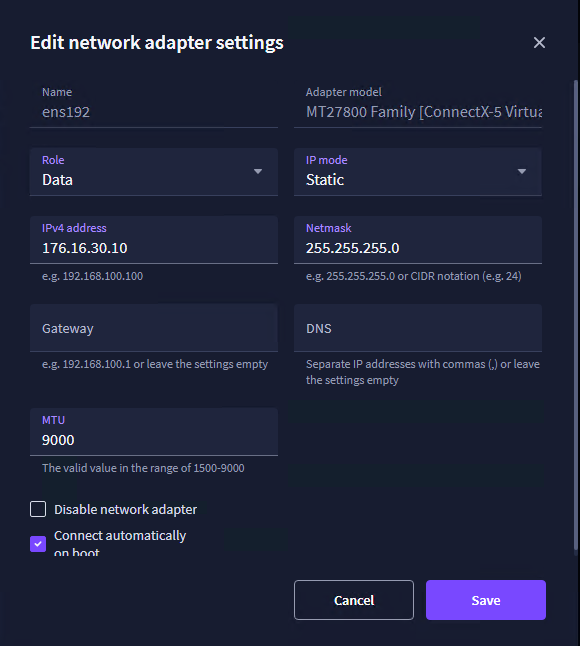
3. Uncheck the “Disable network adapter” checkbox, check the “Connect automatically on boot” checkbox set MTU to 9000, assign the Data role to the network adapter and specify the IPv4 address and network mask. Click Save.
4. The network adapter changes the Link Status to Up.
Create Storage Pool
1. Navigate to the Storage tab, select Physical disks and click Rescan.
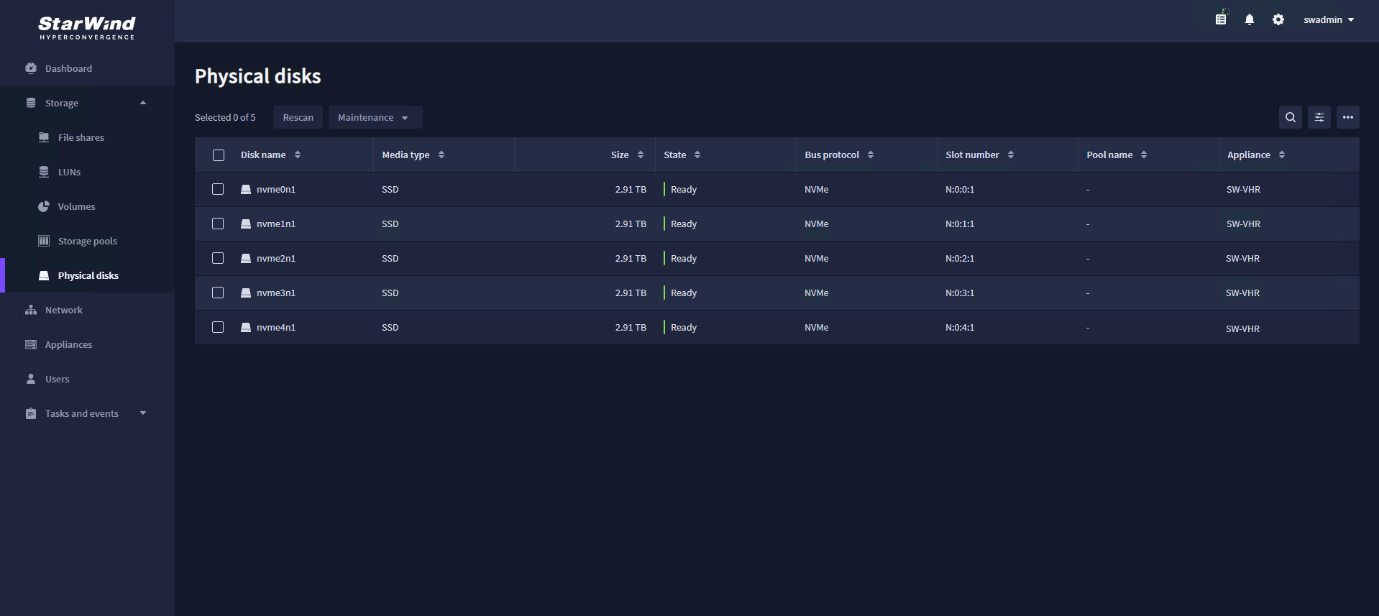
NOTE: StarWind x Veeam Hardened Backup Repository can use storage from a hardware RAID or create a Linux Software RAID or ZFS storage pools from the drives connected to an HBA controller. This guide uses Linux Software RAID as an example.
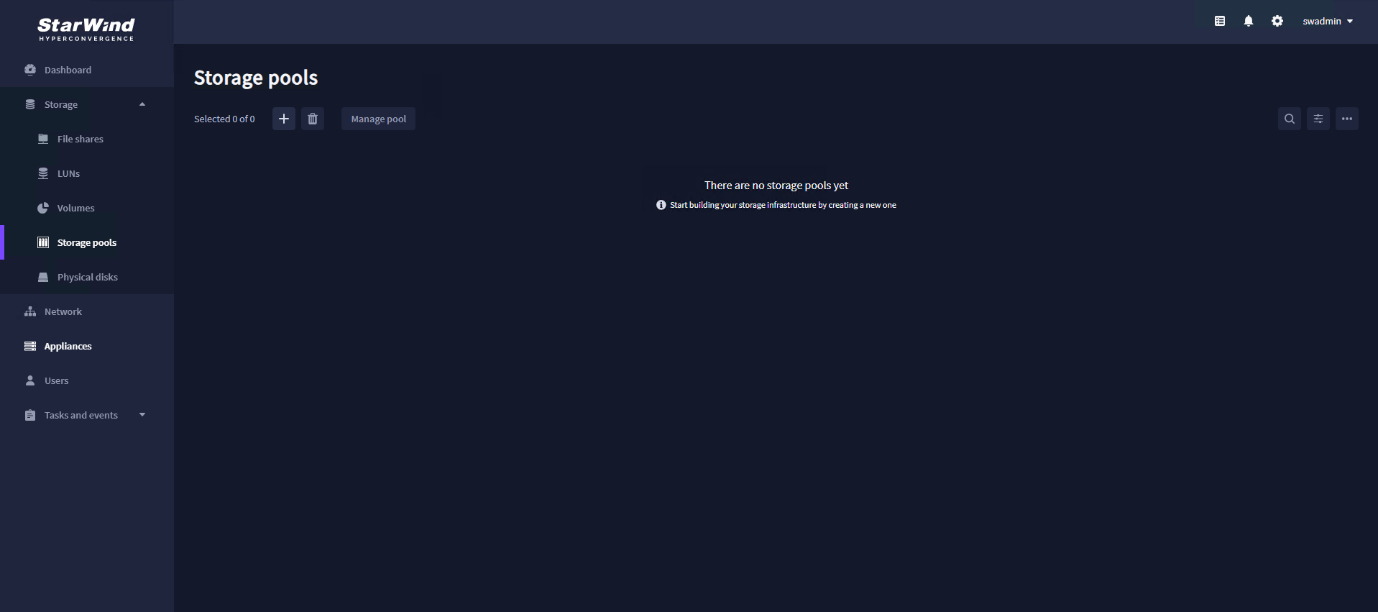
2. In the Storage tab, navigate to the Storage pools and click the “+” sign.
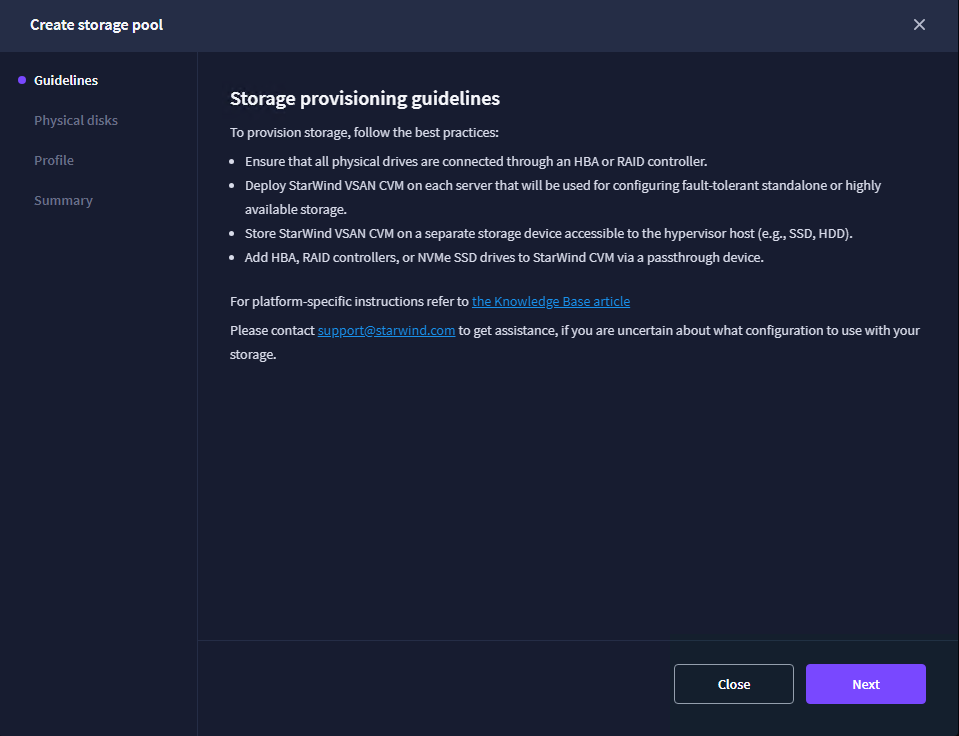
3. Verify the prerequisites and click Next.
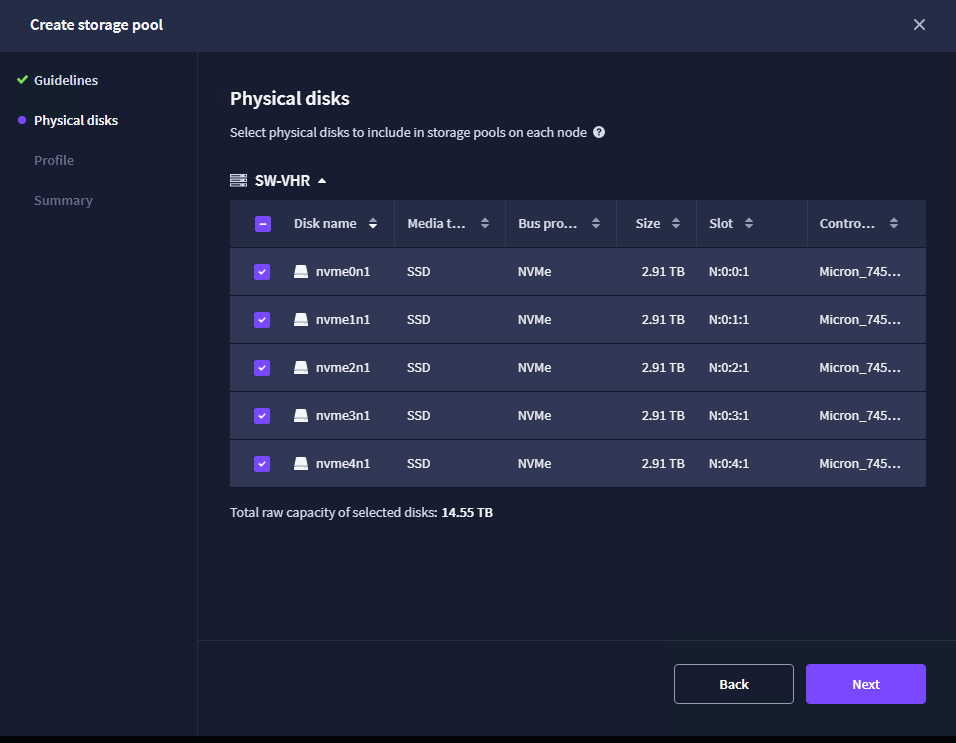
4. Select the drives to create a Linux Software RAID and click Next.
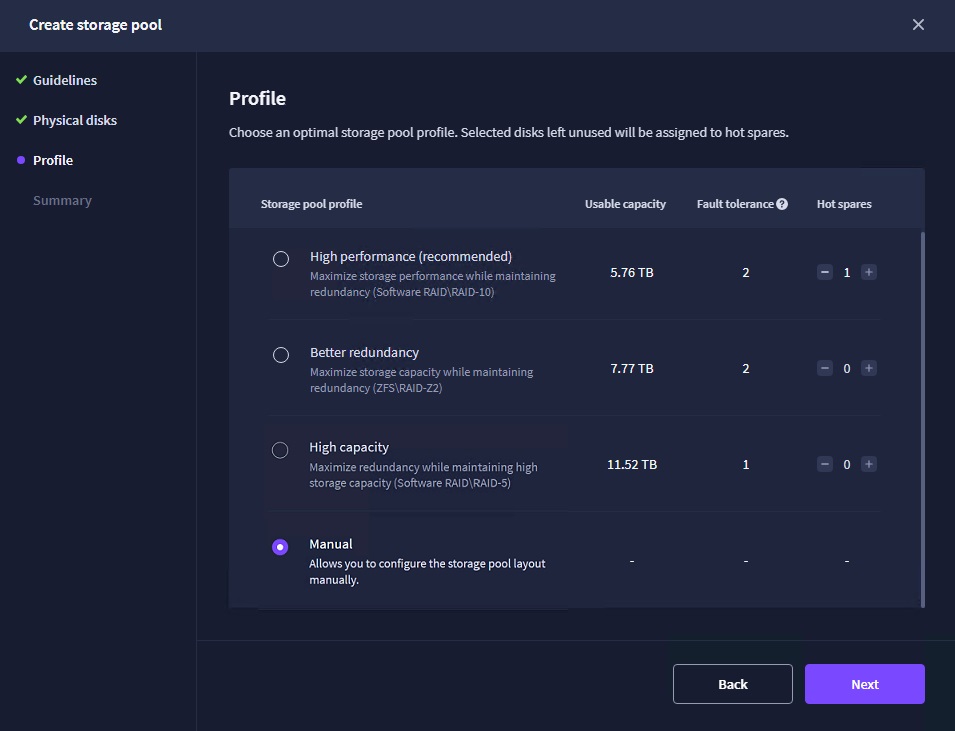
5. Select one of the preconfigured storage profiles or create a redundancy layout for the new storage pool manually according to your redundancy, capacity, and performance requirements. Software RAID-6 is highly recommended. To configure it, select Manual and click Next.
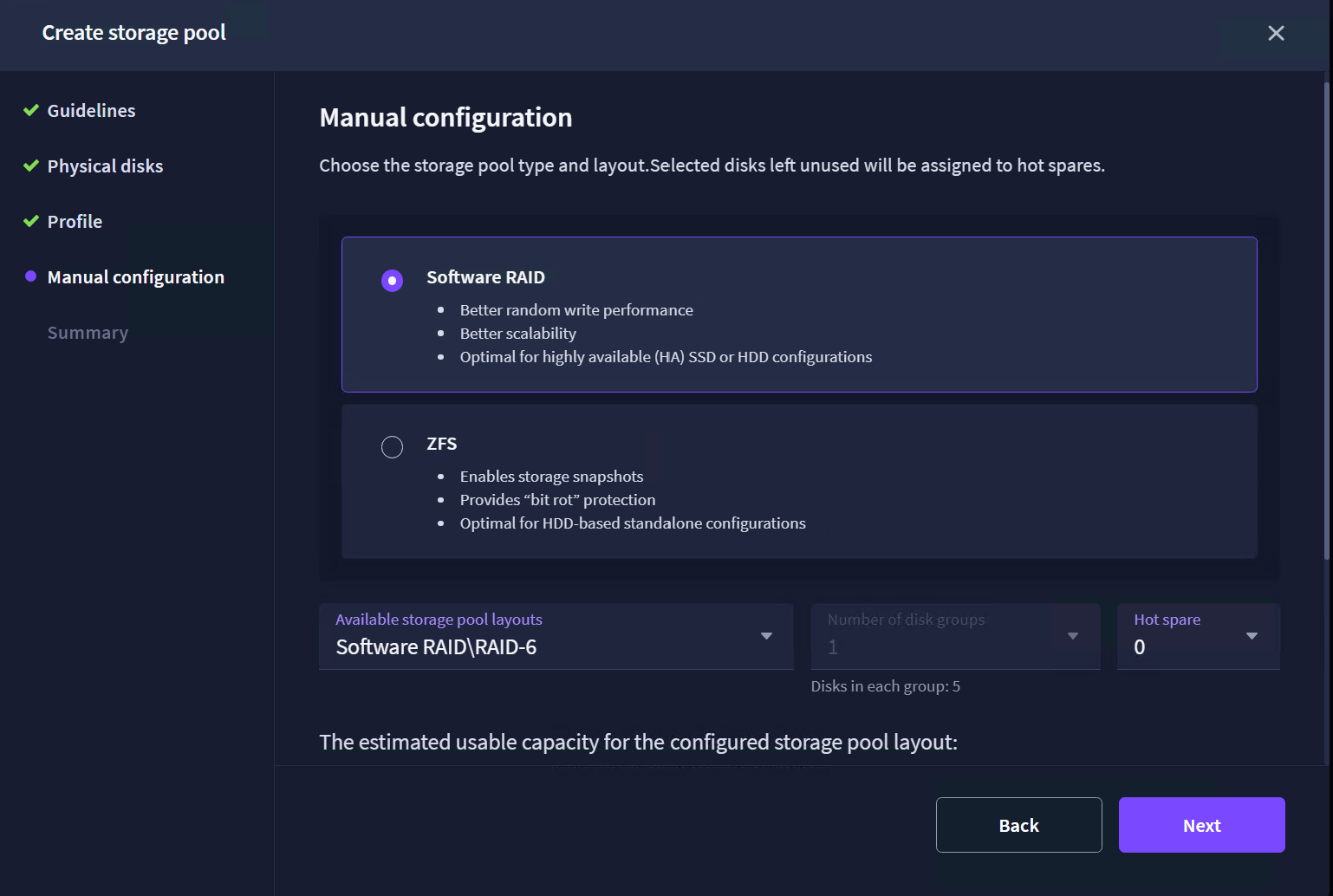
6. Select Software RAID and then select Software RAID\RAID-6 from the Available storage pool layouts. Click Next.
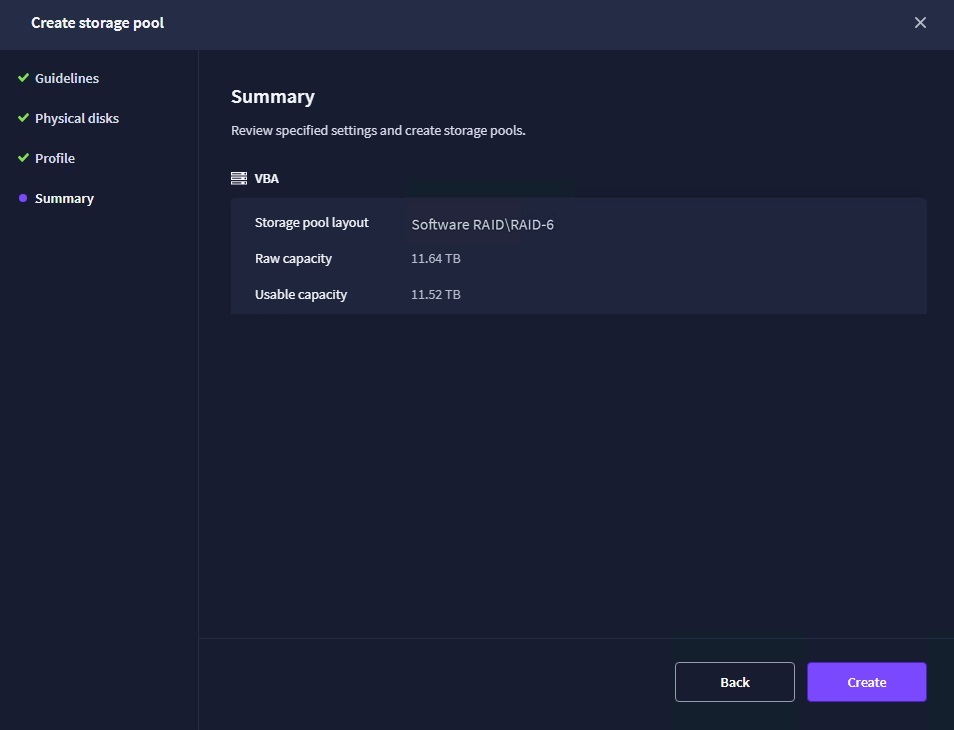
7. Review “Summary” and click the “Create” button to create the storage pool.
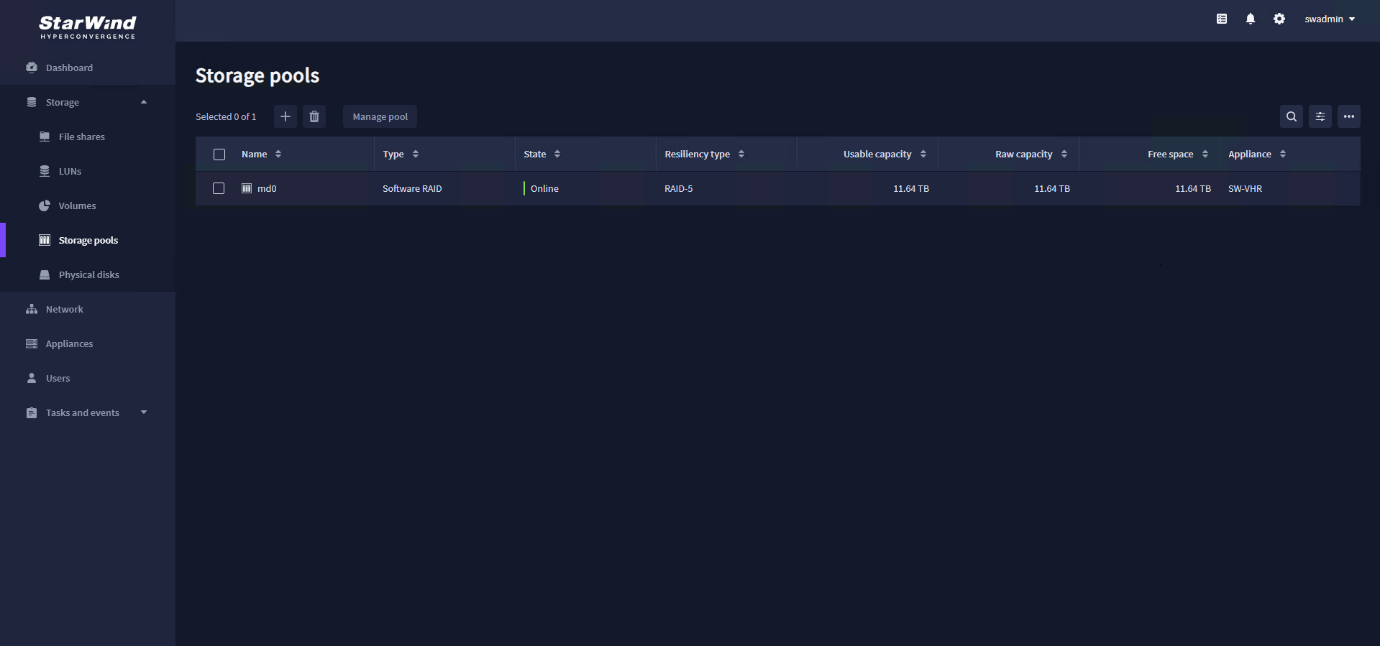
8. Wait until the Linux Software RAID synchronization process is fully complete and its state changes to Online.
Create Backup Repository
StarWind x Veeam Hardened Backup Repository supports the creation of only hardened backup repository and non-hardened backup repository (direct attach Linux repository) for use with Veeam Backup & Replication.
NOTE. Hardened Repository ensures immutability only when used with Veeam Backup & Replication.
Hardened Repository for Veeam Backup & Replication
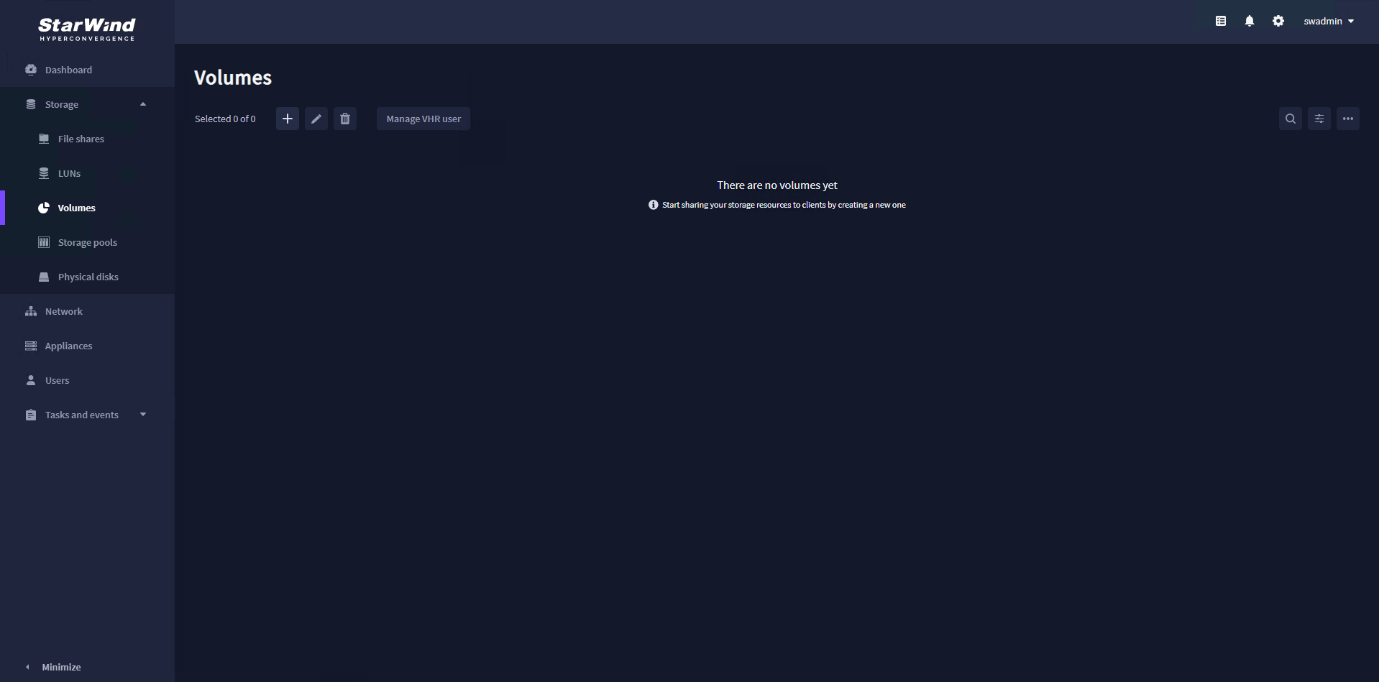
1. Navigate to the “Volumes” tab and click the “+” button to open the “Create volume” wizard.
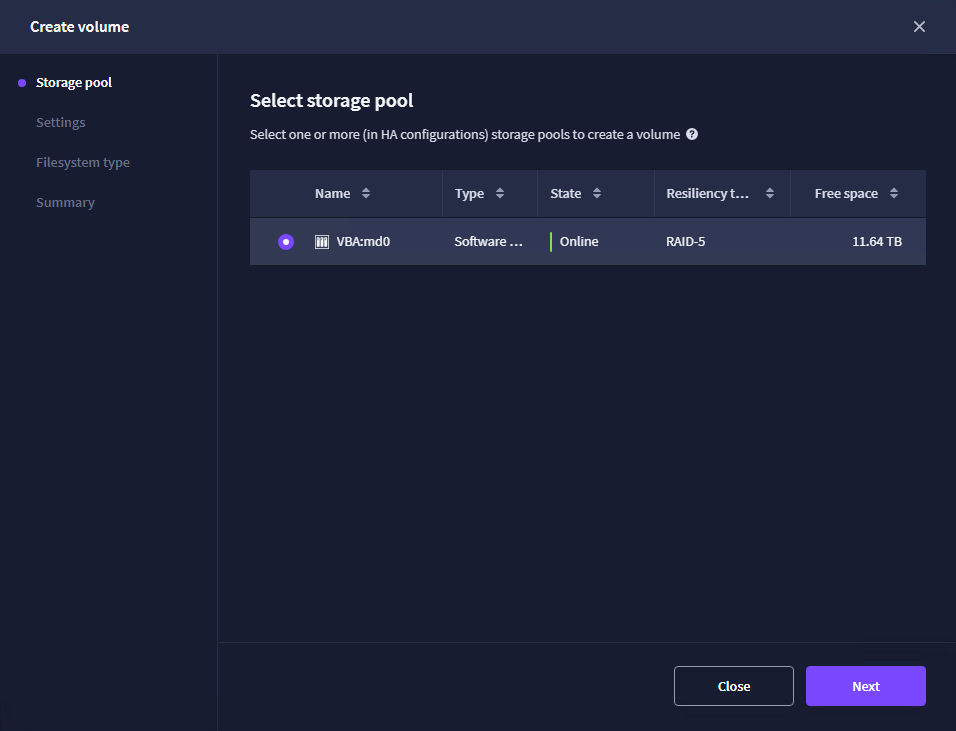
2. Select the storage pool that will be used for a new volume and click Next.
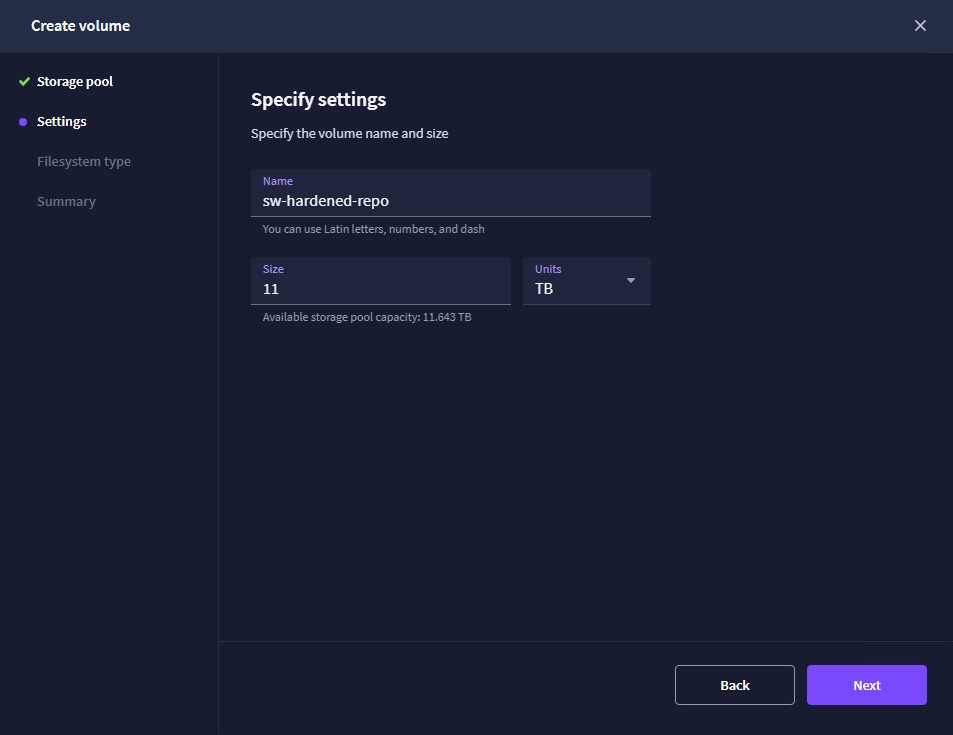
3. Specify the volume name and capacity. Click Next.
4. Select the “Backup repository” for the volume filesystem settings and click Next. The “Backup repository” settings option will configure the volume with additional reflink and CRC check flags.
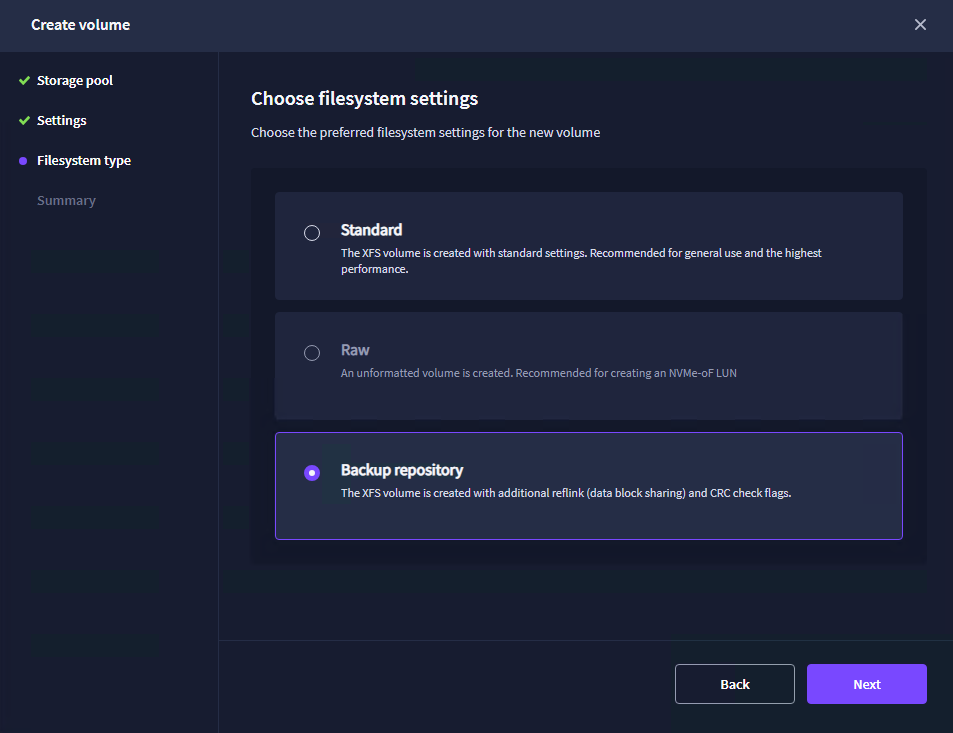
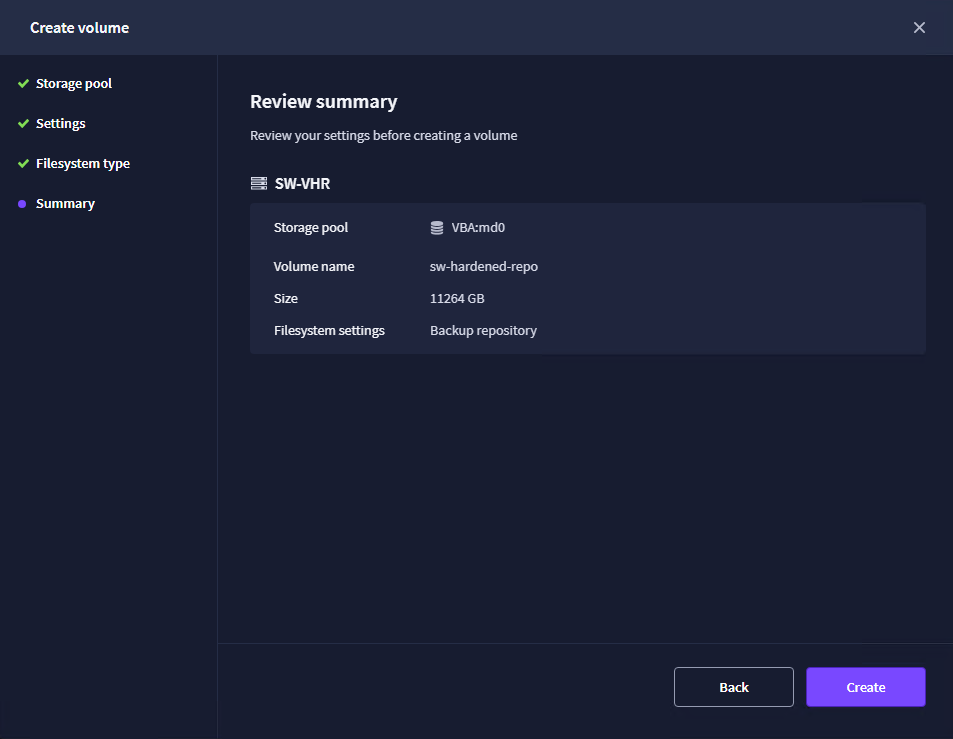
5. Review the summary information and click “Create”.
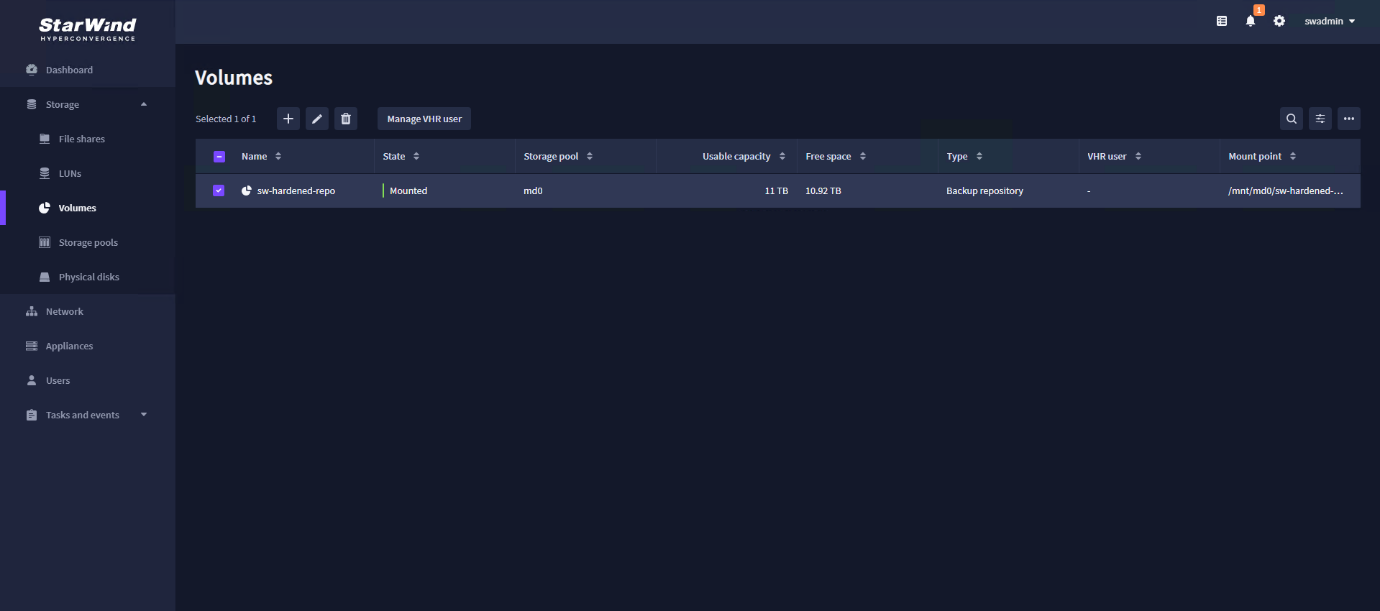
6. In the “Volumes” tab, select the newly created Backup repository volume and click “Manage VHR user”.
7. In the “Manage VHR user” pop-up window, click the “+” button.
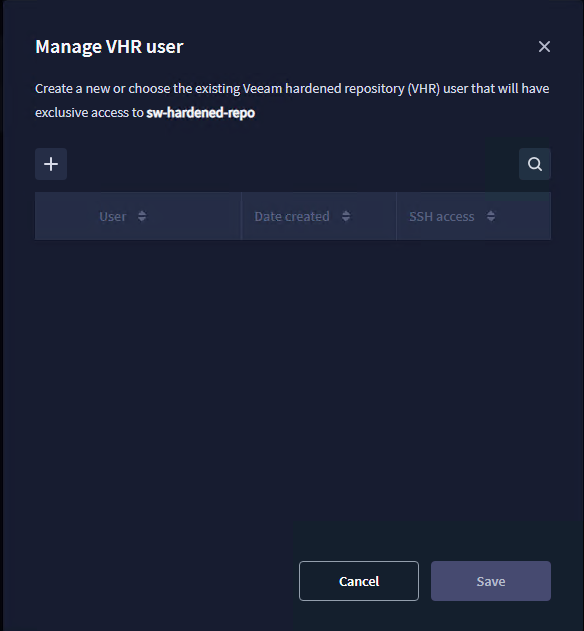
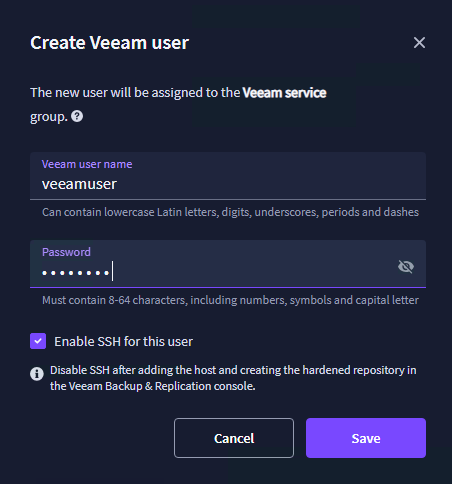
8. Specify the credentials for the new user and make sure to enable SSH access for VHR user. Click Save.
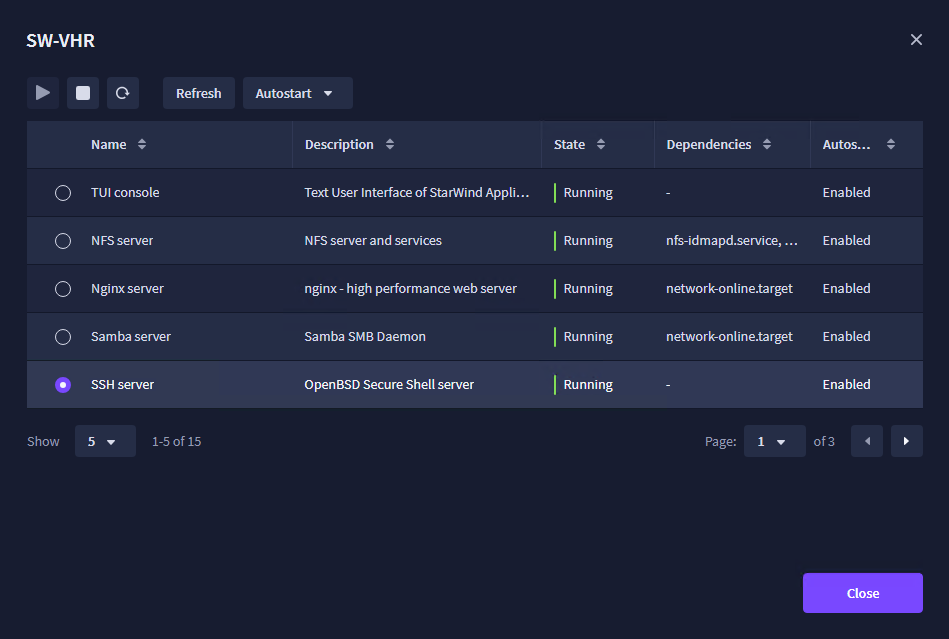
9. Make sure that SSH service is started and running in StarWind x Veeam Hardened Backup Repository CVM, For this, click the “settings icon”, navigate to “Services” and start SSH server.
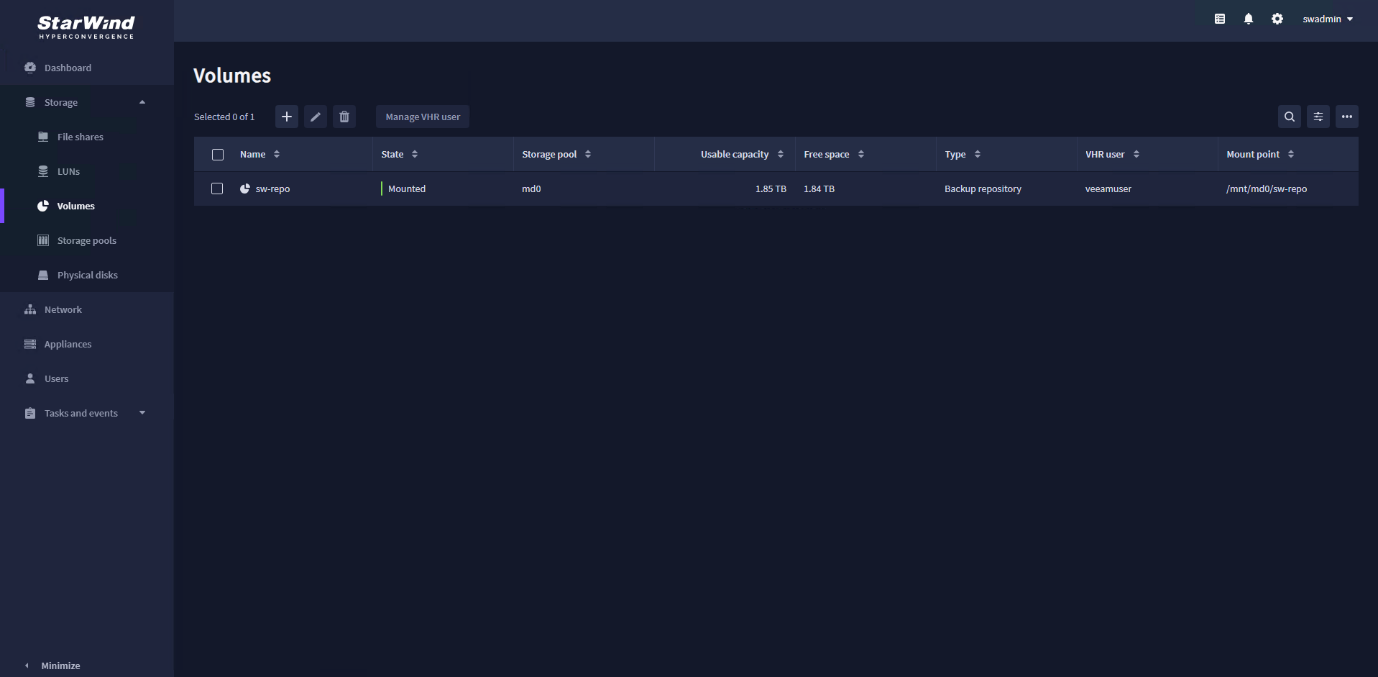
10. The new user has been assigned to the volume that will be used as Veeam Hardened Repository.
Adding Hardened Repository to Veeam Backup & Replication
1. Open the Veeam Backup and Replication console, navigate to “Backup Infrastructure”, and select “Backup Repositories”.
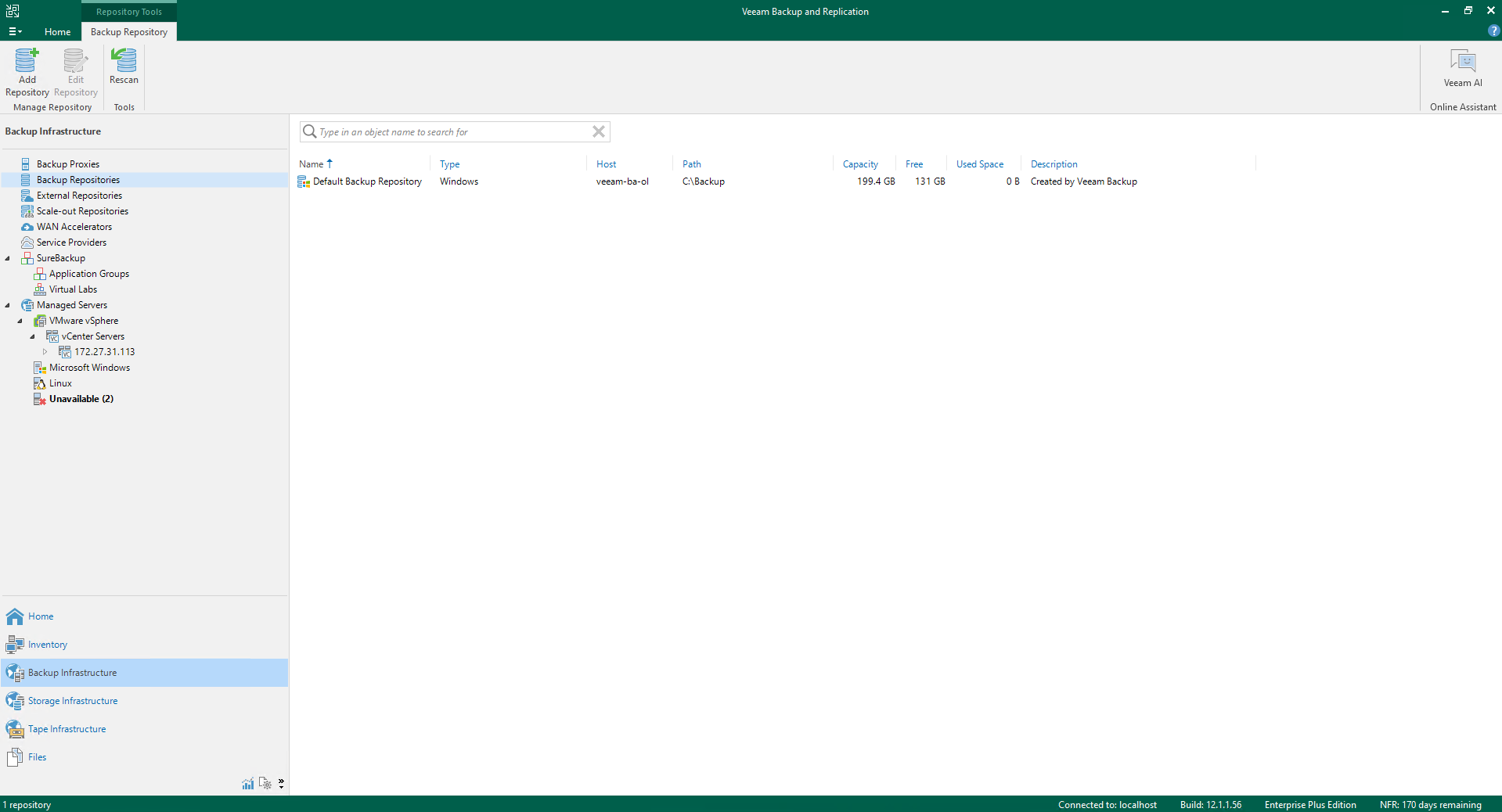
2. Click “Add Repository” and select “Direct attached storage”.
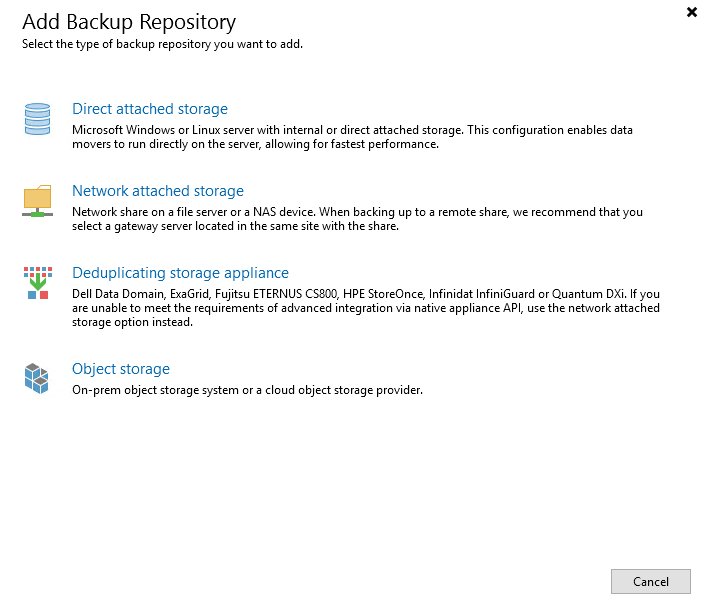
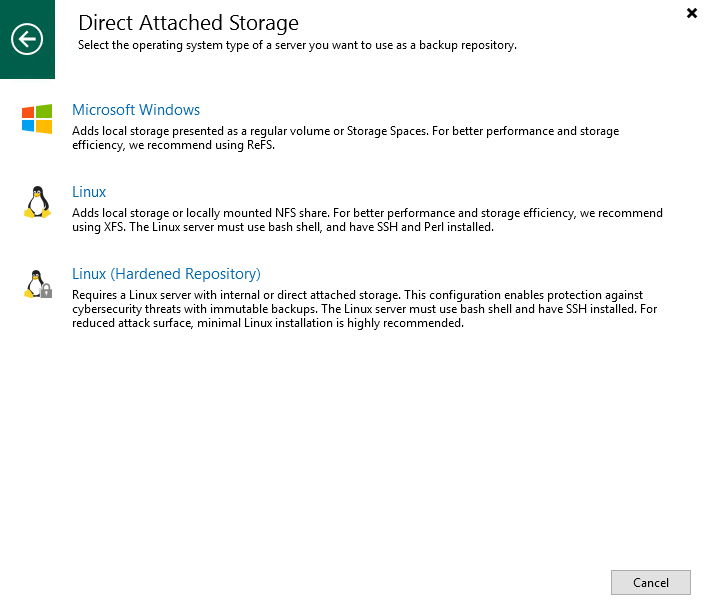
3. Select “Linux (Hardened Repository)”.
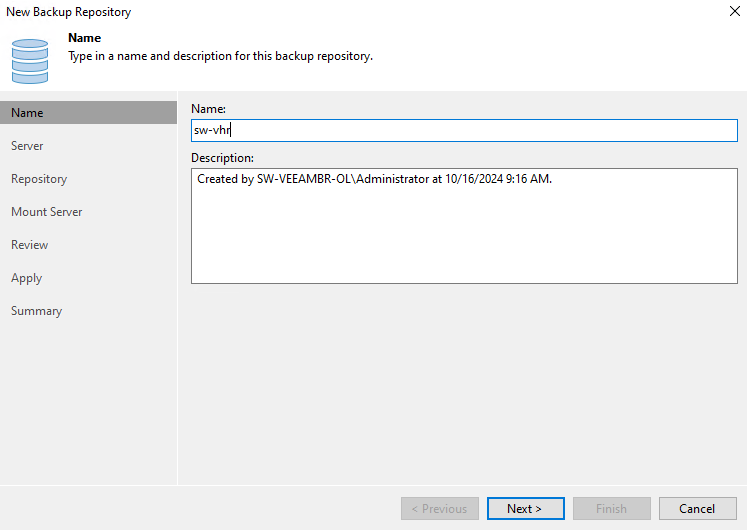
4. In the “New Backup Repository” wizard, specify the name and description for the new repository and click Next.
5. Click “Add New…”.
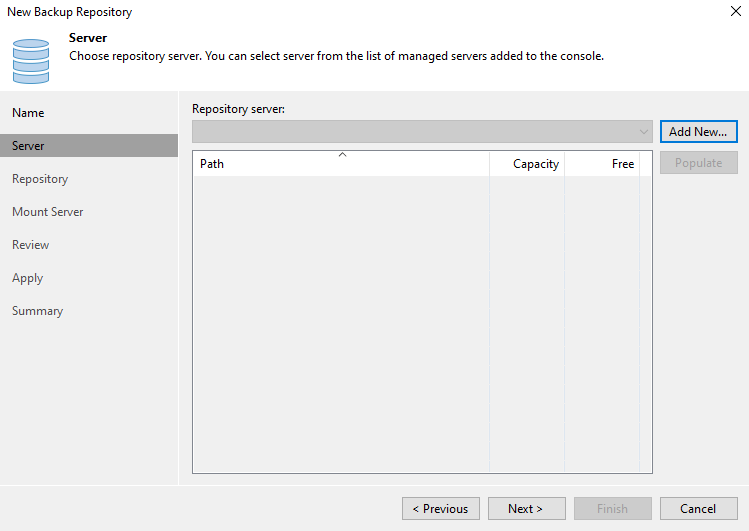
6. In the “New Linux Server” wizard, specify the IP address of the backup traffic network interface (Data) on StarWind x Veeam Hardened Backup Repository CVM and click Next.
NOTE: You can add a backup repository using the management IP address of StarWind x Veeam Hardened Backup Repository CVM or DNS name. It is recommended to add the backup traffic network (Data) to Veeam preferred Networks after the addition of backup repository in case a separate dedicated backup (Data) network is present: https://helpcenter.veeam.com/docs/backup/vsphere/select_backup_network.html?ver=120
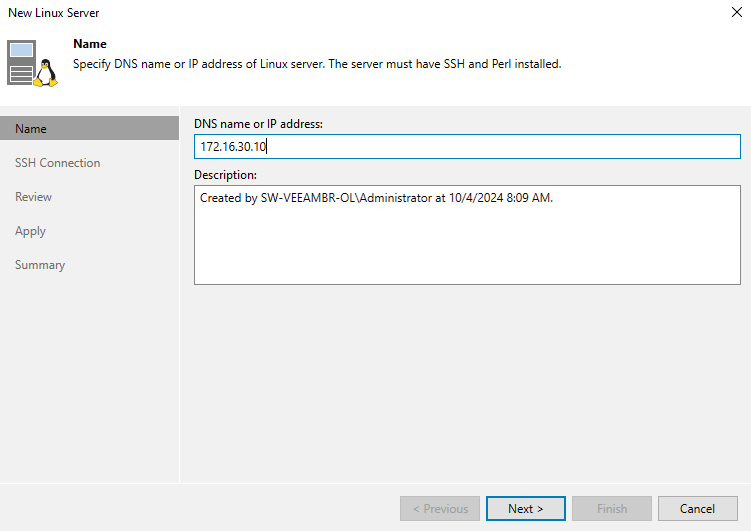
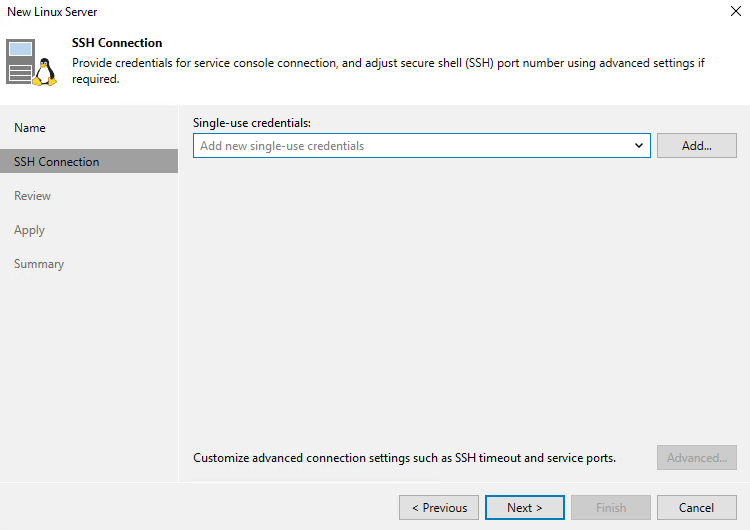
7. Click “Add…” to add the VHR user account created previously that will be used for single-use credentials.
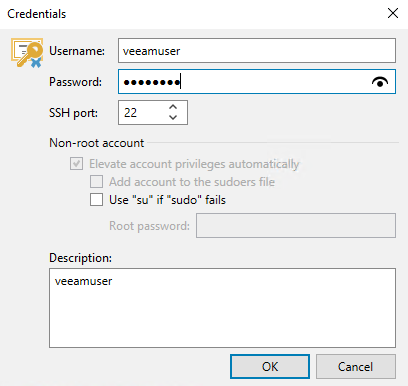
8. Specify the VHR user account credentials and click OK. Specify Advanced settings if required and then click Next.
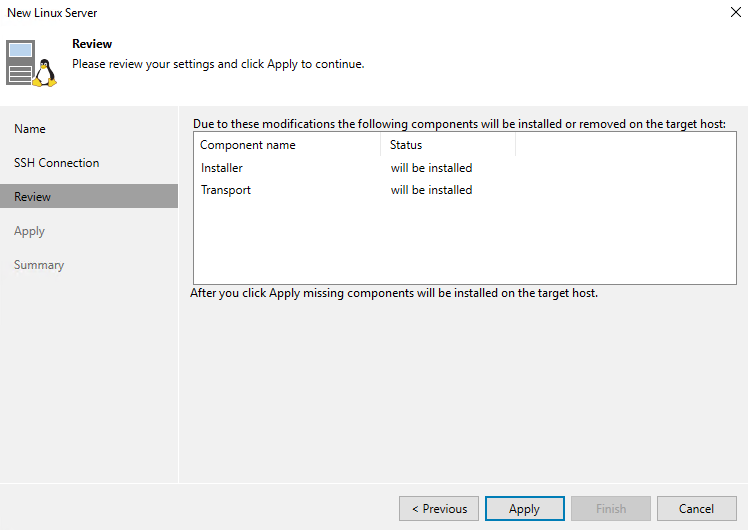
9. Review the components that will be installed and click Apply.
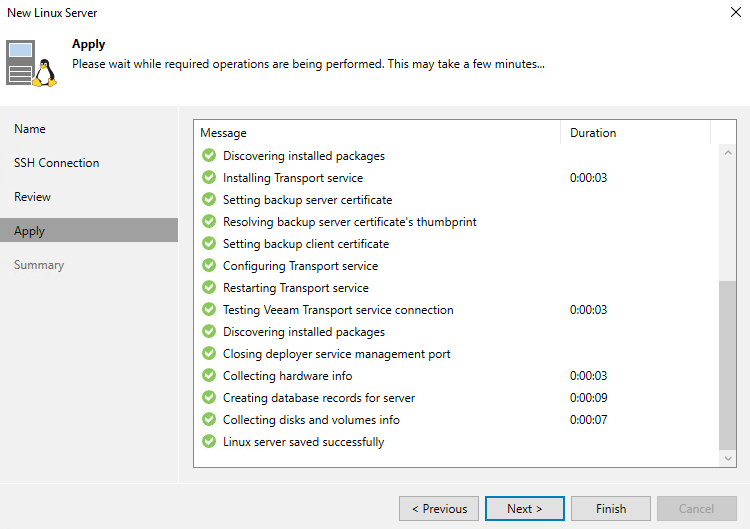
10. Wait until the installation is complete and click Next.
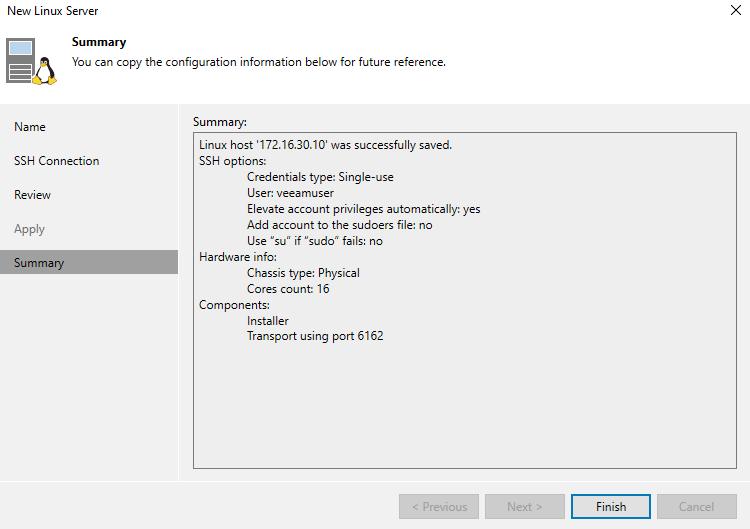
11. Review the summary and click Finish.
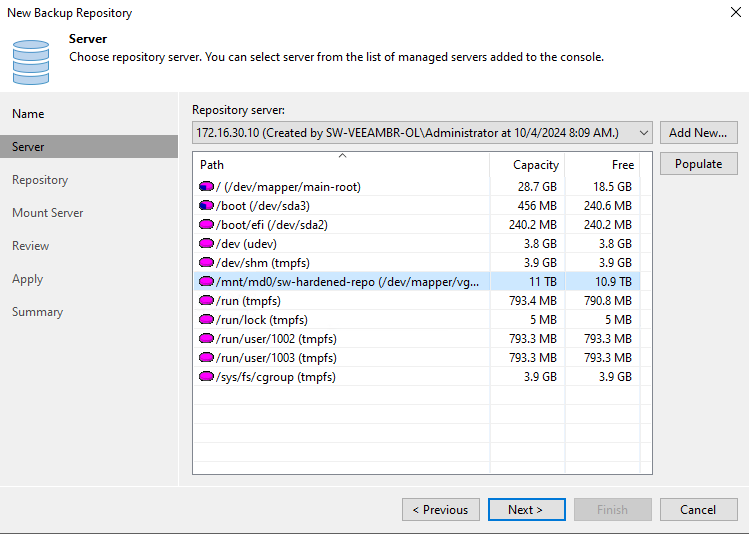
12. In the “New Backup Repository” wizard, select the newly added StarWind x Veeam Hardened Backup Repository server and click “Populate”. Select the Backup repository volume created in StarWind x Veeam Hardened Backup Repository and click Next
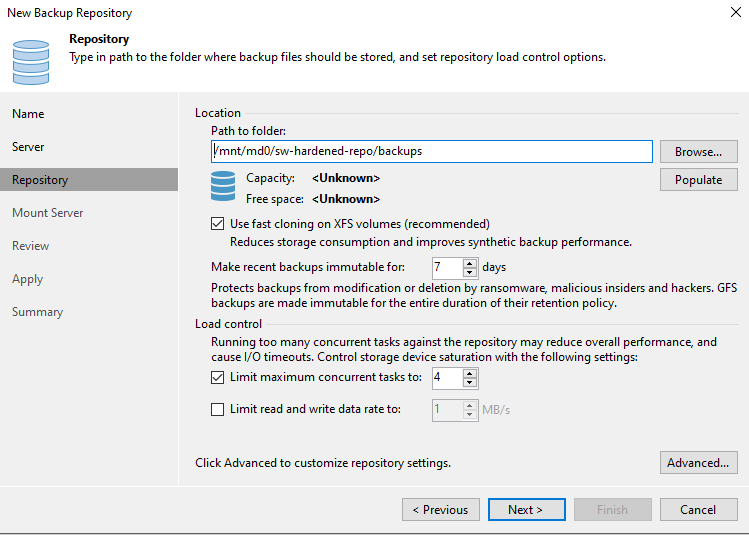
13. Make sure that the “Use fast cloning on XFS volumes” setting is enabled and specify the required retention period for immutability as well as other settings if required. Click Next.
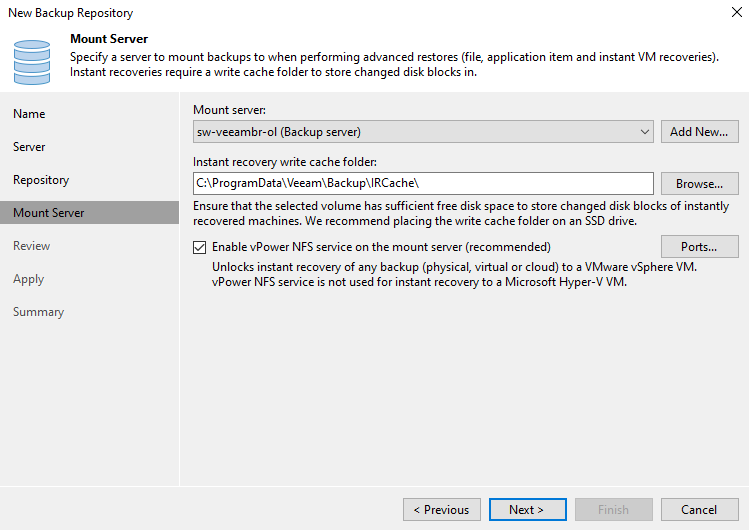
14. Select the Mount server and instant-recovery write cache folder. Specify additional Ports settings if required.
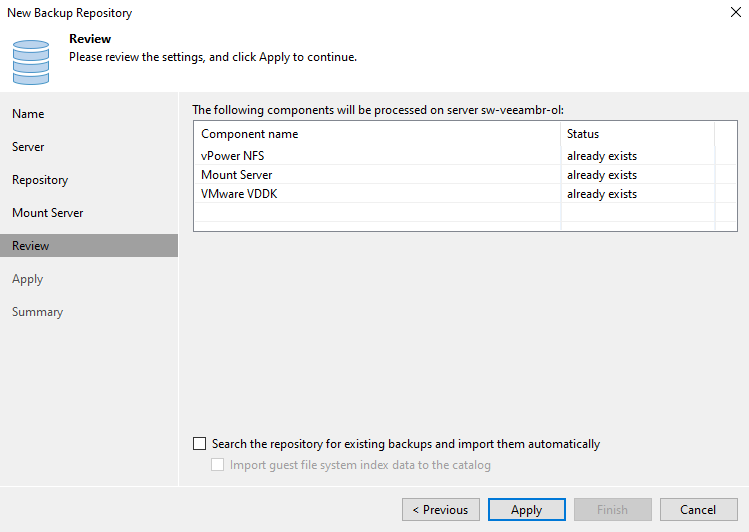
15. Review the settings and components that will be installed and click Apply.
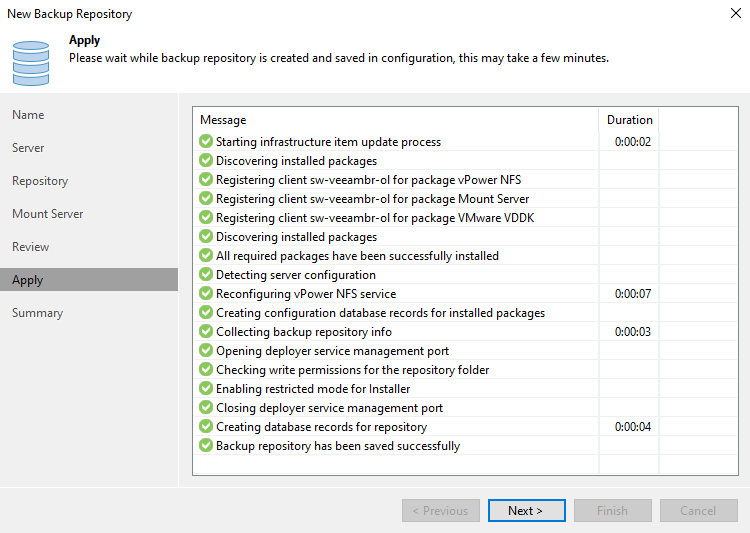
16. Wait until the backup repository is created and click Next.
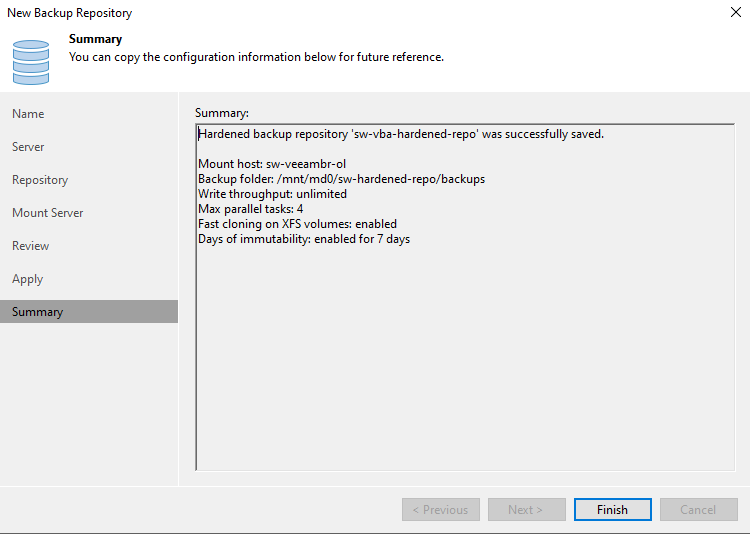
17. Review the summary and click Finish.
18. Veeam prompts whether you want to change the configuration backup location to the newly added repository. Select the preferred option according to your requirements.
19. Hardened Repository has been successfully added to Veeam Backup & Replication.
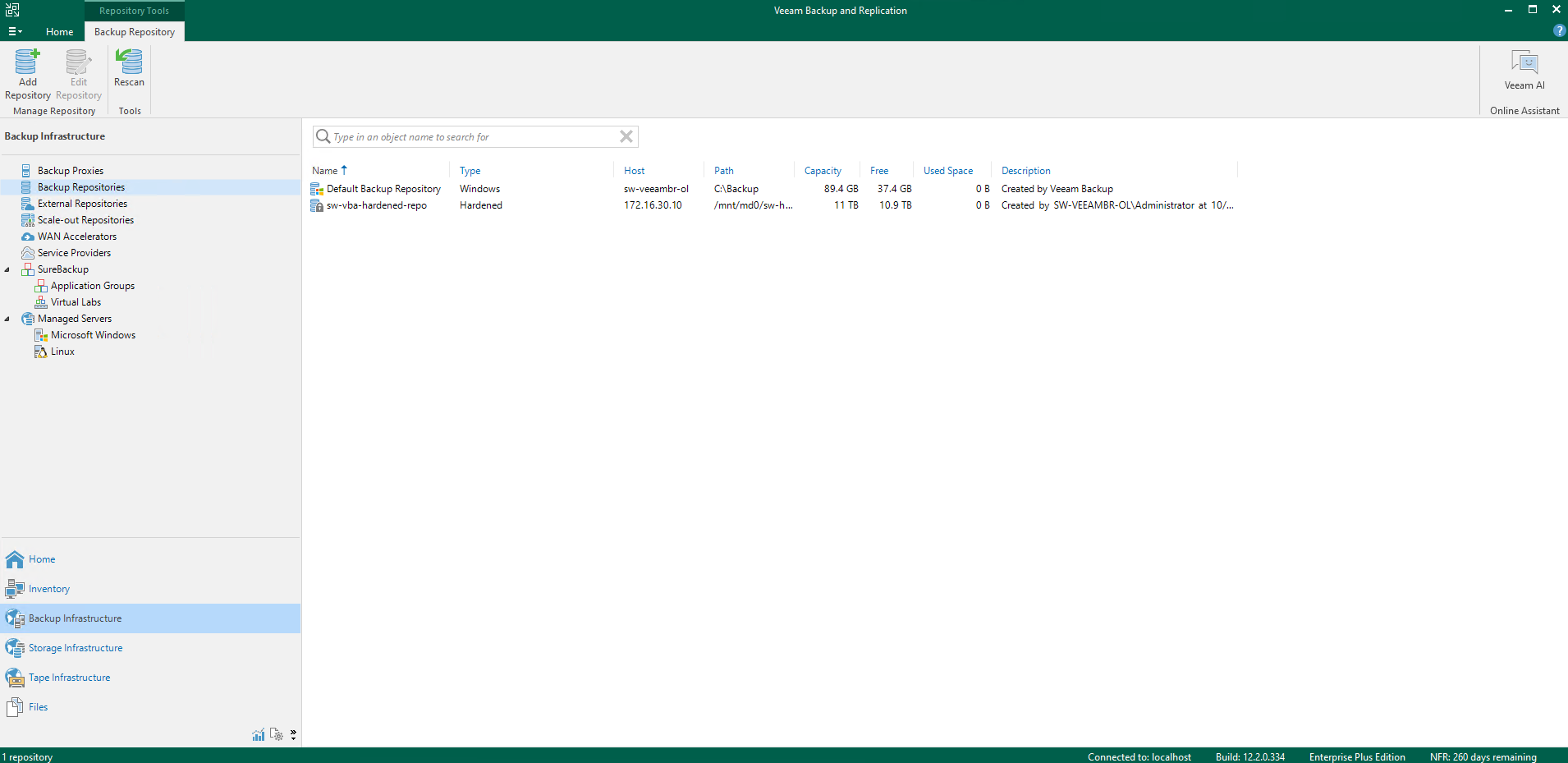
20. Navigate back to the “Volumes” tab in StarWind x Veeam Hardened Backup Repository CVM WEB UI, select the Backup repository volume and click “Manage VHR user”.
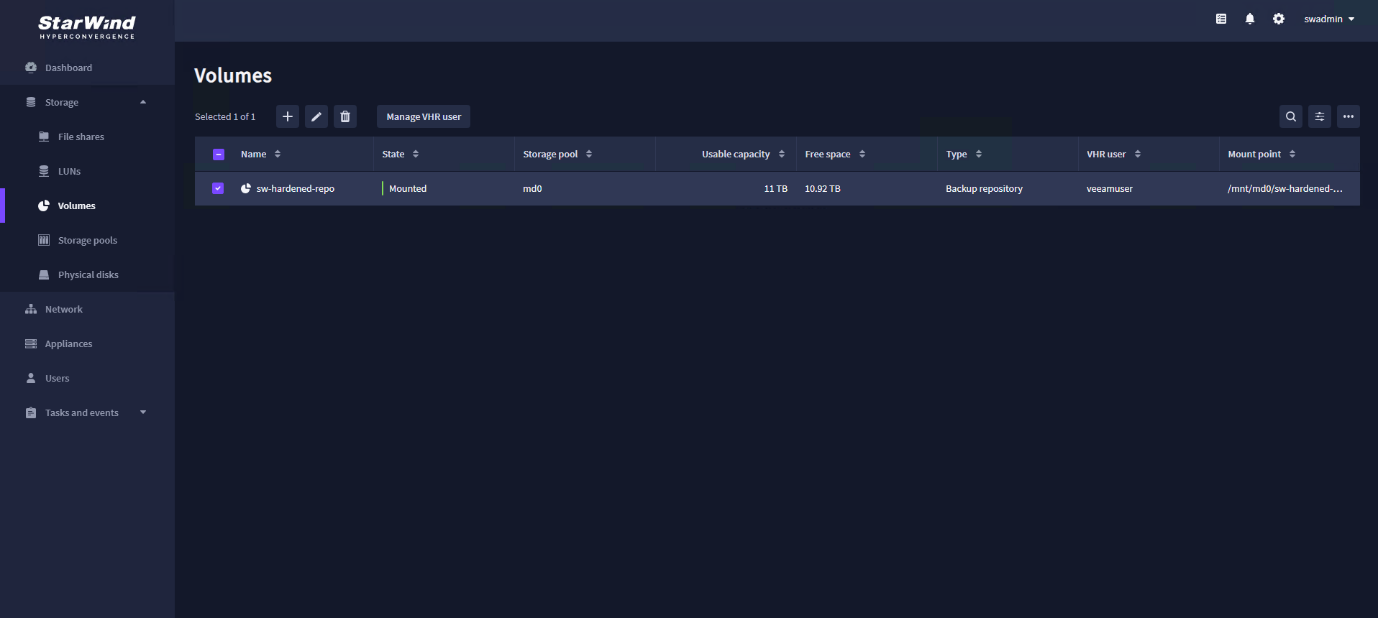
21. Change SSH access to “Disabled” to secure StarWind x Veeam Hardened Backup Repository from potential local threats such as credentials theft. Click “Save”.
Conclusion
Following this guide, StarWind x Veeam Hardened Backup Repository has been configured on a physical bare-metal server using the StarWind Appliance ISO and added to Veeam Backup & Replication.