Hybrid cloud infrastructure is about flexibility. It pulls on-premises gear, private cloud resources, and public cloud services into one environment, so you can pick the right home for each workload. Some apps need the performance and control of an on-premises deployment. Others do better with the scalability of the public cloud. Most IT teams end up running both.
As organizations adopt AI, modern applications, and data-heavy operations, hybrid cloud has become the default way to balance innovation with control. You don’t have to choose between on-premises and cloud. You can use both, and build infrastructure that adapts to changing requirements without giving up security, compliance, or performance.
Why hybrid cloud exists at all?
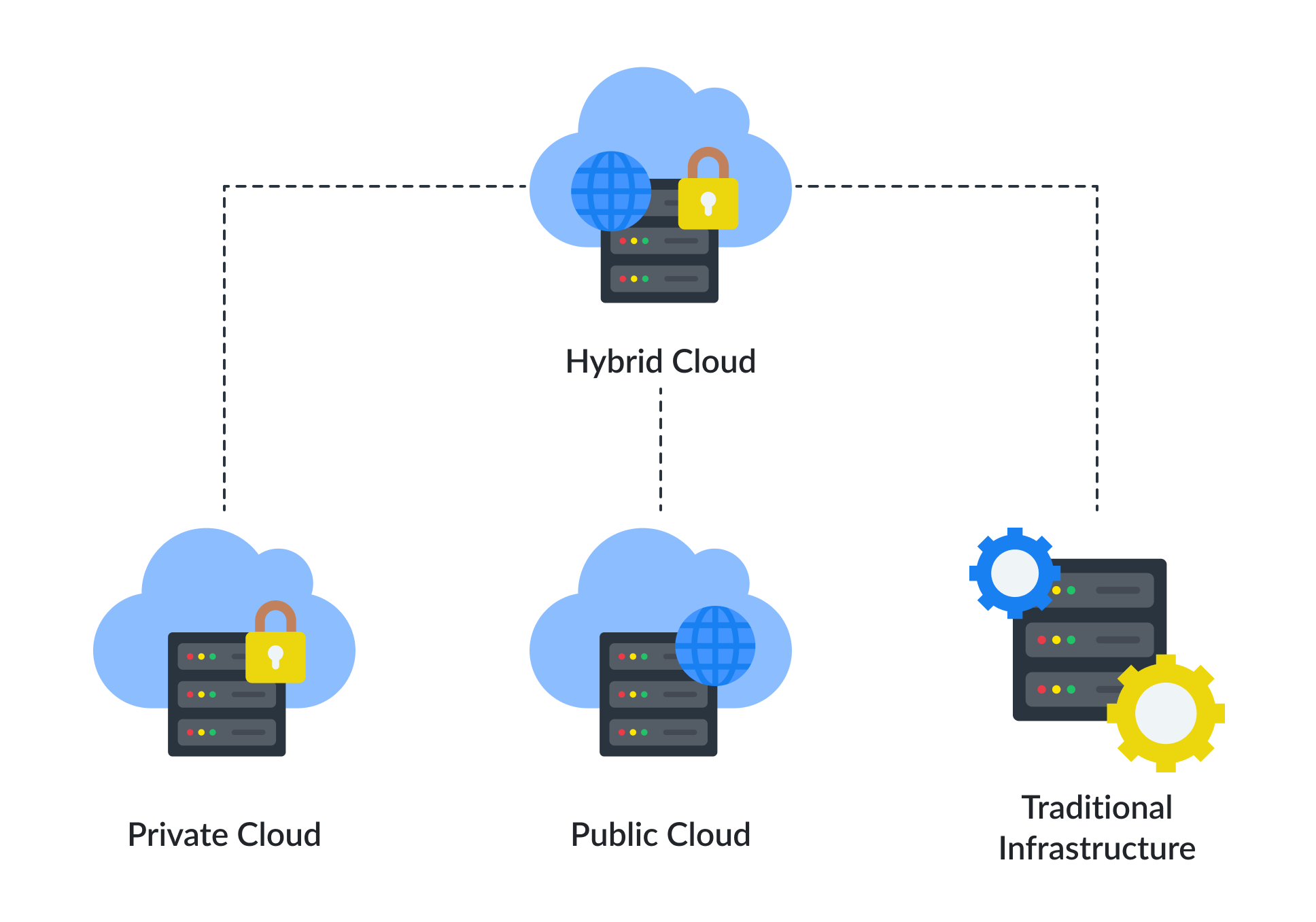
The idea behind a hybrid cloud architecture is straightforward: turn parts of an enterprise’s on-premises data center into a private cloud, then connect that to a public cloud. Apps and data move between the two environments. You get more flexibility, faster scaling, and a wider range of deployment options.
For example, an organization might run web-based email in the public cloud while keeping financial reporting on a private cloud or on-premises infrastructure. The split depends on what each workload actually needs, and that’s where most of the architectural decisions come from in practice.
For hybrid cloud to work, the public and private environments have to integrate and operate as one platform. That happens through LAN, WAN, VPN, and cloud management platforms that give admins a single view across both environments.
Like other cloud setups, hybrid cloud platforms rely on containerization, virtualization, and storage to aggregate resources. Those resources get allocated and shared across environments using dedicated management software.
Building blocks of a hybrid cloud
A working hybrid cloud environment sits on several interconnected layers. Every organization’s architecture looks different, but most hybrid strategies combine four components: on-premises infrastructure, private cloud resources, public cloud services, and edge computing.
These components don’t operate in isolation. Together they form a single ecosystem where applications and data live where they deliver the most value.
On-premises infrastructure
Despite the growth of public cloud, on-premises infrastructure is still a core part of many hybrid strategies. Organizations keep workloads local when they need predictable performance, low latency, strict security controls, or data sovereignty.
For businesses in regulated industries, keeping certain applications and datasets on-premises is often a compliance requirement, not a technical preference. Financial systems, healthcare applications, and manufacturing platforms benefit from the control and reliability that dedicated infrastructure provides, and that’s not something you can easily replicate in a public cloud without significant effort.
Hybrid cloud lets you preserve and extend the value of existing infrastructure investments instead of replacing them. The data center doesn’t have to be an obstacle to modernization. In many environments, it’s still part of a broader cloud strategy.
Private cloud
Private cloud environments bring the advantages of cloud computing (self-service provisioning, automation, resource flexibility) while keeping infrastructure under your own businesses’ control.
For organizations handling sensitive information or operating under strict compliance requirements, private cloud balances agility and governance. Sysadmins can deliver cloud-like experiences to internal users while keeping visibility into security policies, performance, and resource allocation.
Public cloud
Public cloud platforms have become a major driver of innovation, giving organizations access to nearly unlimited compute, storage, and networking on demand. Instead of investing in infrastructure upfront, businesses consume resources as needed and scale quickly when requirements change.
This flexibility makes public cloud a good fit for development and testing environments, seasonal demand spikes, data analytics, disaster recovery, and AI workloads.
Many organizations also use public cloud services to access advanced technologies that would be expensive to build and maintain internally. From machine learning platforms and analytics services to global application delivery, public cloud keeps expanding what organizations can do with their IT infrastructure.
Edge infrastructure
Applications become more distributed and data volumes grow over time. Thus, processing everything in a centralized data center or public cloud isn’t always practical. That’s why edge computing is a proud member of modern hybrid cloud architectures.
Edge infrastructure brings computing resources closer to where data is generated and consumed: a manufacturing facility, retail location, healthcare site, branch office, or IoT deployment. By processing data locally, organizations reduce latency, improve responsiveness, and cut the amount of information that has to travel to centralized environments.
Today, AI is making edge infrastructure more important. Many organizations now run AI inference workloads closer to users and devices, which enables real-time decision-making while reducing bandwidth consumption.
Edge computing is becoming a natural extension of hybrid cloud strategies, helping organizations support distributed operations while keeping centralized visibility and control.
Bringing everything together
The value of hybrid cloud infrastructure comes from how these environments work together. On-premises infrastructure gives you control and performance. Private cloud delivers agility and governance. Public cloud offers scale and innovation. Edge computing enables real-time operations closer to the source of data.
When you integrate these components well, you get a flexible and resilient operating model. You can place workloads where they make the most sense, adapt to changing business requirements, and take advantage of emerging technologies like AI without compromising security, compliance, or operational efficiency.
Benefits of hybrid cloud infrastructure
Organizations don’t move to hybrid cloud because it’s a modern architecture. They adopt it because it solves real business problems: improving agility, supporting AI initiatives, strengthening resilience, or controlling infrastructure costs.
By combining the strengths of private and public cloud environments, hybrid cloud gives you the flexibility to build an IT strategy around business goals instead of the limits of a single platform.
Flexibility and workload mobility
One of the biggest advantages of hybrid cloud is the freedom to run workloads where they perform best.
Not every application has the same requirements. Some workloads demand low latency and direct access to sensitive data, which makes them better suited for on-premises infrastructure. Others benefit from the scalability and global reach of public cloud services. A hybrid approach lets you place each workload in the right environment and move it as requirements change.
This flexibility becomes valuable during periods of growth, digital transformation, mergers, regulatory changes, or evolving customer demands. Instead of redesigning the entire infrastructure, IT teams can adapt quickly and deploy resources wherever they deliver the most value.
Scalability without infrastructure constraints
Business demand is rarely static. Seasonal spikes, new product launches, analytics projects, and AI workloads can create sudden increases in resource requirements.
With a hybrid cloud architecture, organizations can use public cloud resources whenever they need extra capacity without permanently investing in infrastructure that might sit idle during normal operations. This capability, often called cloud bursting, lets businesses respond quickly to changing demands while keeping application performance consistent.
The result is the ability to scale on demand without giving up the control and predictability of private infrastructure.
Better cost optimization
Managing IT costs has gotten more complex as organizations balance traditional infrastructure investments with growing cloud consumption.
Hybrid cloud addresses this by letting businesses align workloads with the most cost-effective environment. Stable, predictable workloads can keep running on existing infrastructure, maximizing previous investments and reducing recurring cloud expenses. Temporary projects, development environments, and variable workloads can take advantage of the public cloud’s pay-as-you-go model.
This balanced approach often delivers a stronger return on investment while giving you more financial flexibility as business needs evolve.
Stronger security and regulatory compliance
Security and compliance remain top priorities for organizations operating in heavily regulated environments. While public cloud providers continue to invest in security, many businesses still need direct control over specific applications, datasets, and operational processes.
A hybrid cloud model gives you the best of both worlds. Sensitive data, regulated workloads, and mission-critical applications can stay within private infrastructure, while less sensitive workloads use public cloud services.
This approach helps organizations meet data sovereignty requirements, industry regulations (HIPAA, PCI-DSS, GDPR, depending on the sector), and internal governance policies while still benefiting from cloud innovation and scalability.
Improved business continuity and disaster recovery
If you’ve ever dealt with a major outage, you already know that downtime is expensive. Hardware failures, cyberattacks, natural disasters, or human error: every minute of disruption affects users, revenue, and operations.
Hybrid cloud architectures improve resilience by providing multiple layers of protection across different environments. Critical applications and data can be replicated between on-premises infrastructure and cloud platforms, so workloads stay available when disruptions occur. Recovery processes can also be automated, reducing downtime and supporting strict recovery objectives.
For many businesses, hybrid cloud has become a cornerstone of modern disaster recovery and business continuity planning because it provides both flexibility and redundancy without requiring a secondary physical data center.
Accelerating AI and application modernization
AI is changing infrastructure requirements faster than almost any technology trend in recent years. Training models, running analytics, and supporting machine learning workloads often need computing resources (GPU clusters, high-memory instances, fast interconnects) that would be costly or impractical to maintain entirely on-premises.
Hybrid cloud provides a foundation for these initiatives. You can keep sensitive datasets within private infrastructure while using cloud-based resources for AI model training, analytics, and high-performance computing. This lets teams innovate faster while maintaining control over security, compliance, and costs.
The same flexibility supports application modernization. Instead of replacing existing infrastructure all at once, organizations can gradually adopt cloud-native technologies, containers, and automation platforms (Kubernetes, Terraform, Ansible are common picks) while continuing to run critical workloads on existing systems.
For most businesses, modernization is an ongoing process, and hybrid cloud provides a way to move forward without unnecessary disruption.
A foundation for future growth
Perhaps the biggest benefit of hybrid cloud infrastructure is that it gives organizations options. Technology requirements change rapidly, and very few businesses can accurately predict where their workloads will need to run several years from now.
By combining private and public cloud capabilities into a unified operating model, hybrid cloud creates a flexible foundation that can evolve alongside the business. Whether you’re supporting AI initiatives, expanding to edge locations, meeting compliance requirements, or enabling future innovation, hybrid cloud lets your infrastructure adapt without constant redesigns.
Common hybrid cloud use cases
Hybrid cloud has evolved far beyond its original role as a bridge between on-premises infrastructure and public cloud services. Today, it’s a strategic operating model that helps organizations balance performance, scalability, security, and cost efficiency across a wide range of business initiatives.
Business continuity and disaster recovery
Disaster recovery has traditionally required significant investment in secondary infrastructure that sits idle most of the time.
Hybrid cloud offers a more flexible and cost-effective approach. Critical workloads and data can be replicated to cloud environments, creating a secondary recovery location without the need to maintain duplicate infrastructure. In the event of a hardware failure, cyberattack, or site-wide outage, applications can be restored quickly, minimizing downtime and keeping business operations running.
The result is greater resilience while avoiding many of the costs associated with traditional disaster recovery models.
Modernizing data protection strategies
Data protection requirements keep growing as organizations manage larger datasets, stricter compliance requirements, and more sophisticated cyber threats.
Hybrid cloud addresses these challenges by combining local infrastructure with scalable cloud storage. Critical production workloads can stay on-premises for performance and control, while backup data, archives, and long-term retention repositories go to the cloud.
This approach gives organizations more flexibility, nearly unlimited storage scalability, and better protection against ransomware, accidental deletion, and infrastructure failures.
Accelerating application modernization
Application modernization rarely happens overnight. Hybrid cloud lets organizations modernize gradually by moving selected services, development environments, or application components to the cloud while keeping core systems on-premises.
This incremental approach reduces risk, preserves existing investments, and lets teams take advantage of technologies like containers, automation, and cloud-native services without disrupting day-to-day operations.
Enabling AI and data-driven innovation
AI has quickly become one of the strongest drivers of hybrid cloud adoption. Most AI initiatives need access to large datasets and substantial computing resources. Public cloud platforms are often well suited for model training, analytics, and high-performance processing, but many organizations still need to maintain control over sensitive information, intellectual property, and regulated data.
Hybrid cloud balances these competing requirements. A healthcare provider might keep patient records within its private infrastructure to comply with HIPAA while using cloud-based AI services to analyze anonymized datasets and improve diagnostics. A manufacturer can process operational data locally while using cloud platforms to develop predictive maintenance models and optimize production workflows. This enables faster AI adoption without sacrificing security, compliance, or cost control.
Supporting compliance and data sovereignty
Regulatory requirements continue to shape infrastructure decisions across healthcare, finance, government, and legal services. Many organizations in these sectors face strict requirements governing where data can be stored, processed, and accessed.
Hybrid cloud provides the flexibility to meet these requirements without giving up the advantages of cloud computing. Sensitive data can stay within private infrastructure or designated geographic locations, while less regulated workloads benefit from the scalability and innovation available through public cloud services.
Hybrid cloud challenges
Hybrid cloud has real benefits, but it also comes with limitations. Here’s what businesses run into.
Managing multiple environments
One of the most common challenges is maintaining operational consistency across different platforms.
IT teams often need to manage on-premises infrastructure, private cloud resources, public cloud services, and edge environments. Without centralized visibility and management, organizations struggle with fragmented operations, inconsistent policies, and growing administrative overhead.
Establishing unified management practices is essential for maintaining control while preserving the flexibility that hybrid cloud provides.
Maintaining consistent security
Security gets more complex when workloads and data move across multiple environments. Different platforms may use different security controls, access policies, and operational processes, making it hard to enforce consistent protection standards.
A successful hybrid cloud strategy requires a unified approach to identity management, access control, encryption, threat detection, and compliance monitoring. Consistency matters because security gaps often emerge at the boundaries between environments rather than within individual systems.
Keeping data synchronized
Data is the foundation of modern business operations, but managing it across multiple environments is challenging. Applications frequently rely on information stored in different locations, requiring organizations to maintain accurate, up-to-date copies of data across private and public infrastructure.
Achieving this balance requires thoughtful planning around replication, data movement, integration, and governance. Without a clear strategy, organizations risk creating performance bottlenecks, unnecessary complexity, or inconsistent data states.
Managing network performance and latency
Hybrid cloud environments depend heavily on reliable connectivity. Applications, users, and services often communicate across multiple locations, making network performance a critical factor in overall user experience.
This becomes even more important as organizations expand their use of AI, edge computing, and distributed applications. Workloads that require real-time communication can be particularly sensitive to latency, making network design central to overall architecture planning. For applications that need sub-10ms response times, the physical distance between on-premises resources and cloud regions can be the deciding factor in where the workload runs.
Improving cost visibility
One of the promises of hybrid cloud is greater cost efficiency. Achieving it, however, requires visibility. Organizations often struggle to understand how resources are consumed across on-premises infrastructure and public cloud platforms.
Ongoing monitoring, governance, and optimization help ensure infrastructure spending matches business priorities. Better visibility also makes it easier to identify underutilized resources and avoid unnecessary costs.
Bridging the skills gap
Hybrid cloud environments combine technologies from multiple domains: virtualization, storage, networking, cloud platforms, cybersecurity, automation, and AI infrastructure.
Finding professionals with expertise across all of these areas is difficult. Many organizations address this challenge through automation, operational standardization, and ongoing training. These investments help reduce complexity while improving consistency and operational efficiency.
Turning complexity into opportunity
The challenges associated with hybrid cloud are real, but they’re rarely barriers to success. Many organizations view them as opportunities to modernize operational processes, strengthen governance, and increase automation.
Modern infrastructure management platforms continue to mature and automation becomes more sophisticated, operating hybrid cloud environments is getting easier than it was a few years ago. Organizations that establish clear governance models, invest in visibility and automation, and align infrastructure decisions with business objectives are well positioned to get the full value of hybrid cloud.
For many businesses, the conversation has shifted. The question is no longer whether to adopt hybrid cloud, but how to use its potential as the foundation for future innovation, resilience, and growth.
FAQ
What is the difference between a hybrid cloud and a multi-cloud?
A hybrid cloud combines on-premises infrastructure with one or more public or private cloud environments that work together as a single operating model. A multi-cloud strategy, on the other hand, uses services from multiple cloud providers but doesn’t necessarily include on-premises infrastructure or require those environments to be tightly integrated. Many organizations use both approaches, building a hybrid cloud while consuming services from multiple public cloud providers.
How does hybrid cloud support AI initiatives?
Artificial intelligence (AI) workloads often require significant computing resources for model training, data analytics, and inference. A hybrid cloud allows organizations to leverage scalable cloud infrastructure for AI processing while keeping sensitive datasets, intellectual property, or regulated information within private infrastructure. This helps balance innovation with security, compliance, and cost control.
What are the biggest challenges of managing a hybrid cloud?
The most common challenges include managing multiple environments, maintaining consistent security policies, synchronizing data across locations, controlling cloud spending, and ensuring reliable connectivity between on-premises and cloud resources. Organizations typically address these challenges through centralized management, automation, governance policies, and standardized security practices.
How does StarWind support hybrid cloud infrastructure?
StarWind helps organizations build highly available private cloud infrastructure that integrates with public cloud services. Solutions such as StarWind Virtual SAN enable software-defined shared storage using existing servers, while the StarWind HCI Appliance provides a turnkey platform for running business-critical workloads. Together, these solutions simplify hybrid cloud deployments, improve business continuity, and provide a cost-effective foundation for integration with services such as Microsoft Azure and Amazon Web Services (AWS).
Is hybrid cloud suitable for small and mid-sized businesses?
Yes. Hybrid cloud is no longer limited to large enterprises. Modern software-defined infrastructure allows small and medium-sized businesses to build resilient private cloud environments without investing in expensive enterprise storage systems or maintaining multiple data centers. This makes it possible to adopt hybrid cloud strategies that improve availability, scalability, and disaster recovery while keeping infrastructure costs under control.
Conclusion
Hybrid cloud infrastructure has become one of the most practical approaches to modern IT operations because it matches how organizations actually run their workloads: some on-premises, some in the cloud, many moving between the two as requirements change.
If you’re starting from scratch, the right move is to map your workloads before you map your architecture. Identify which applications need low latency, which ones handle regulated data, and which ones can tolerate the variability of public cloud. That exercise usually tells you more about your hybrid strategy than any vendor pitch will.
For organizations already running a mix of infrastructure, the harder work is operational: consistent security policies, unified monitoring, and clear cost visibility across environments. Get those right, and the technology choices tend to fall into place.