
A company can protect production data well and still fail a compliance review. If backups sit in the wrong region, SaaS vendors process personal data without a DPA, or logs can’t prove who accessed regulated data, the gap is already there. Data security protects information. Data compliance proves how that information was handled – where it was stored, who processed it, which vendors touched it, how long copies were retained, and what happened when something went wrong.
You’ll need to handle this across cloud, SaaS, backup, disaster recovery, and AI environments. Each one adds surface area.
What is data compliance?
Data compliance is the practice of collecting, storing, processing, protecting, retaining, and sharing data according to applicable laws, industry standards, customer contracts, and internal policies. It covers personal data, payment card data, healthcare records, employee information, audit logs, backup copies, and any sensitive business data that regulations define as requiring protection.
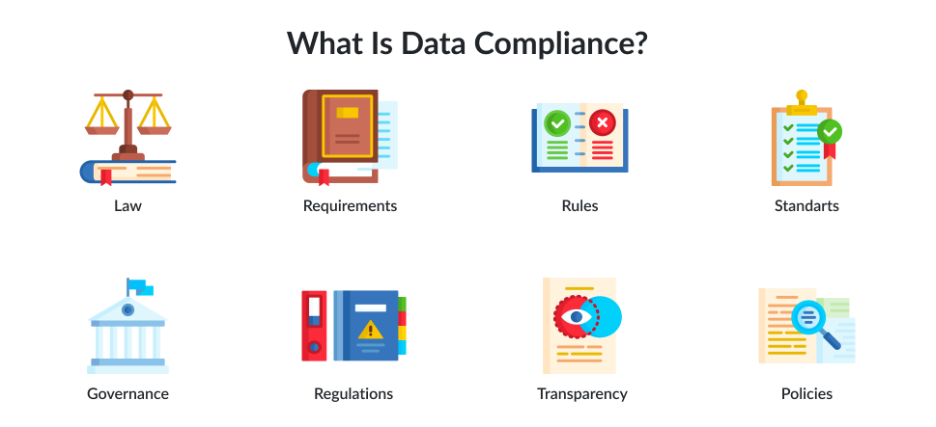
It’s not a one-time certification. The scope changes every time your organization adds a SaaS tool, backup provider, analytics platform, cloud region, support integration, or AI workflow.
Data compliance vs data security vs data governance
These three overlap and get conflated constantly – which is part of why compliance programs have gaps.
| Term | Focus | Example |
|---|---|---|
| Data compliance | Following applicable laws, standards, contracts, and internal policies | A DPA exists for the main CRM, but not for the support analytics tool that receives customer tickets |
| Data security | Protecting data from loss, misuse, or unauthorized access | Production database is encrypted, but exported backups are stored without customer-managed keys |
| Data governance | Managing data ownership, quality, lifecycle, and policies | Retention policy says logs are kept for 12 months, but the SIEM deletes them after 30 days |
Security protects data. Governance defines ownership and lifecycle rules. Compliance proves that the required controls are actually operating.
Data compliance regulations and standards you’ll face
Most organizations are subject to multiple frameworks simultaneously. Here’s what auditors and customers are actually asking about.
| Regulation / standard | Scope | Common compliance focus | Evidence auditors or customers may ask for |
|---|---|---|---|
| GDPR | Personal data of people in the EU | Lawful basis, data minimization, DPAs, breach notification, international transfers | Records of processing, DPA register, SCCs or adequacy basis, breach log, deletion workflow |
| CCPA / CPRA | California consumer personal information | Rights to know, delete, correct, opt out of sale/sharing | DSAR workflow, opt-out process, privacy notice, vendor list, request history |
| HIPAA | US healthcare data / ePHI | Administrative, physical, and technical safeguards; BAAs; audit controls; risk analysis | Risk assessment, BAA register, access logs, incident response records, encryption decision documentation |
| PCI DSS | Cardholder data environment | Scope control, protection of stored account data, encrypted transmission, logging, access control | Network diagrams, CDE scope, vulnerability scans, access reviews, backup protection records |
| SOC 2 | Service organizations | Design and operation of controls across security, availability, confidentiality, processing integrity, or privacy | Type II report, control tests, exceptions, vendor controls, access reviews |
| DORA | EU financial sector ICT risk | ICT risk management, incident reporting, resilience testing, third-party ICT risk | ICT asset register, third-party contracts, test records, incident classification, exit plans |
| EU AI Act | AI systems placed on or used in the EU | Risk classification, data governance, record-keeping, transparency, high-risk AI obligations | AI system inventory, training data documentation, risk assessment, logs, human oversight records |
A common summary of GDPR breach notification is “72 hours,” but the actual requirement is notification to the supervisory authority without undue delay and, where feasible, within 72 hours after becoming aware of a personal data breach, unless the breach is unlikely to create risk for individuals. The nuance matters when you’re building incident response procedures.
HIPAA has its own oversimplification making the rounds. HHS states that encryption is an addressable implementation specification under the current Security Rule, meaning the entity must assess whether it’s reasonable and appropriate, implement it if so, or document an equivalent alternative. It’s not blanket mandatory.
DORA entered into application on 17 January 2025 and introduced EU-wide ICT resilience and third-party risk obligations for financial entities, with oversight of critical ICT third-party providers. The EU AI Act entered into force on 1 August 2024. Most obligations apply from 2 August 2026, with phased exceptions.
Why is data compliance important?
GDPR fines have reached hundreds of millions of euros for repeat violations. PCI DSS non-compliance can revoke a company’s ability to process cards entirely – not just a fine, but losing the ability to take payments. For mid-size organizations, the more immediate risk is contractual: enterprise customers now require SOC 2 or equivalent certifications as a procurement condition, and a failed audit can block deals in progress.
Cloud adoption increases the surface area. Production data may stay in a compliant region, but replication targets, monitoring logs, support access bundles, and vendor SaaS integrations can all move data outside the approved scope without explicit architectural controls. Most SOC 2-certified companies have at least one of these: a cloud backup vendor added without a DPA, or a DR replication target in a region the data’s residency requirements don’t permit.
What auditors actually check?
Underneath the different acronyms and enforcement mechanisms, most frameworks check for the same things.
Data inventory. Without a live map of where sensitive data sits – across production, SaaS, backups, logs, and integrations – every control downstream is unreliable. If you can’t produce your data inventory quickly, that’s a compliance gap MFA and encryption won’t fix. Your inventory should cover system owner, data type, region, vendor, retention period, subprocessors, and last review date.
Access controls. Least privilege limits who can reach regulated data, and admin accounts on sensitive systems need MFA. Teams drift here without noticing: a developer gets added to a production database for a debugging session and the access never gets revoked. Broad permissions accumulate through exactly this kind of drift. A quarterly IAM review should document reviewers, removed users, privileged accounts, exceptions, and approval dates.
Encryption parity. Teams that encrypt production databases but ship unencrypted backup exports run two compliance postures without realizing it. HIPAA and PCI DSS don’t make exceptions for secondary copies. Neither do most enterprise contracts. Your database backup report should show encryption status, key ownership, target region, retention period, and immutability settings.
Logging. Logs turn controls into evidence. They should capture who accessed what data, when, from where, and what changed. Many organizations run logs. Fewer retain them long enough, or in enough detail, to answer what auditors actually ask. Your SIEM retention report should include log source, retention period, access events, admin activity, and evidence that standard admins can’t edit logs.
Retention and deletion. Nobody deletes data. It piles up in archives, cold storage, backup sets from three years ago, and forgotten SaaS exports. GDPR‘s data minimization principle means all of it is a liability if you can’t justify keeping it – “just in case” isn’t a lawful basis for retention. Map your retention policy to storage lifecycle rules, with deletion request history, backup expiration settings, and documented exception approvals.
Vendor DPAs. Every SaaS tool that processes personal data needs a DPA. The gap usually isn’t the main CRM or ERP. It’s the analytics vendor added in Q3, the support platform integrated last year, the productivity tool someone signed up for without going through procurement. Your vendor register should show DPA status, data categories processed, storage region, subprocessors, incident notification terms, and renewal date. DPAs don’t auto-generate when you click Accept.
Cloud, SaaS, and hybrid environments
Choosing eu-west-1 doesn’t make you GDPR compliant. The region covers where production data lives. It doesn’t address where logs go, where backup copies land, or whether monitoring agents are sending telemetry somewhere unexpected. All of that needs documentation before an auditor asks.
Here’s a setup that catches teams off guard: Frankfurt production database, DR replica outside the EU, third-party backup service storing copies in Virginia. If any of that data contains EU personal data, the replication arrangement requires a transfer mechanism – Standard Contractual Clause or adequacy decision – even though production data technically never left the EU.
SaaS due diligence has a short checklist that’s frequently skipped: DPA in place, sub-processor list available, residency options documented, SOC 2 Type II in hand, incident notification terms defined. Most procurement processes catch the first two. The rest surface during audits.
Backup, disaster recovery, and audit readiness
This is where careful teams get surprised.
The two most common gaps both come from applying production standards to secondary copies and assuming they’ll match. Backup jobs that replicate to a region outside the approved scope create residency violations even when production storage is compliant. Backup exports stored without encryption – or encrypted with keys the vendor manages rather than the data owner – create a separate issue. Neither generates alerts. Both show up under audit.
Restore testing is where backup compliance most often fails. A backup policy with no restore tests has never been validated, and the gaps surface during incidents rather than beforehand. DORA explicitly requires documented testing of recovery procedures for financial entities. S3 Object Lock and equivalent features on on-premises object stores implement immutability at the storage layer, regardless of which credentials are used.
AI and data compliance
AI compliance failures look different from traditional ones. The data doesn’t get stolen. It ends up in a training set, a prompt log, or a RAG result, reaching someone who was never supposed to see it. The DPA requirement applies to AI providers the same way it applies to any other data processor.
Using a consumer AI tool without a signed Art. 28 GDPR agreement is simply non-compliant, regardless of what the provider claims about not training on enterprise data. You need enterprise tiers or API integrations with proper DPAs in place before any personal data touches the model.
Prompt-level PII filtering reduces harm but falls short as a compliance control. It primarily covers text inputs and mostly ignores AI features that operate on data automatically: email summaries, smart suggestions, tool calls on the user’s behalf. Organizations managing this more systematically deploy central proxies between users and LLM providers – Azure OpenAI endpoints or custom API gateways where policies are enforced at the technical layer and prompts get logged for DPO lookbacks. Under Art. 25 GDPR, Privacy by Design means if an employee can paste customer records into an AI tool with nothing stopping it, the standard hasn’t been met.
The EU AI Act adds formal requirements for high-risk AI systems – hiring tools, credit scoring, healthcare AI, critical infrastructure – including documented training data provenance and ongoing record-keeping, with full applicability from August 2026. A practical concern comes before the regulation even applies: a support-ticket RAG system built without scoping retrieval to match the original helpdesk access controls means any user can surface tickets they were never authorized to see. The compliance failure isn’t in the model. It’s in the permissions layer.
Common data compliance mistakes
Treating compliance as a paperwork exercise produces the most audit failures. Policies exist, but the controls they describe often don’t match what’s actually running, and there’s no evidence trail covering the discrepancy.
Not knowing where sensitive data lives makes every subsequent control unreliable. Teams that skip the data inventory assume their data exists only in systems they deliberately set up. That assumption stops holding after a few years of SaaS adoption, API integrations, and tools someone added without a full procurement review.
Broad admin access and untested restores are both friction problems. Nobody wants to revoke access and risk breaking something. Nobody wants to run a restore drill and discover the backup estimate was off. Both are easy to defer indefinitely, which is how compliance programs accumulate gaps in the two areas that matter most during an incident.
Collecting audit evidence only when an audit is coming. The period auditors care about most is the one between your last audit and this one. That’s when gaps show up.
On-premises and HCI for compliance-constrained deployments
Some organizations have hard requirements around where data can live and who can access the infrastructure. Healthcare, finance, public sector, defense, and regulated edge environments all face this.
Cloud can support compliance, but only if regions, replication, support access, subprocessors, and transfer mechanisms are documented. In environments where physical control and local data residency are central requirements, on-premises, co-located, or edge infrastructure may be easier to govern.
Edge and branch deployments are a common case. Running compute and storage locally can keep regulated data inside a defined physical scope and reduce dependency on WAN links. HCI platforms support this pattern by combining compute, storage, virtualization, and management in a smaller operational footprint.
On-premises doesn’t make you compliant by default. But when the infrastructure boundary is smaller and more controlled, it’s easier to document and prove where data lives, how it’s replicated, who can access it, and whether backups actually restore.
Conclusion
Compliance programs fail when evidence is assembled reactively – after a customer, auditor, or regulator starts asking questions. Build that evidence into day-to-day operations: current data inventory, reviewed access, tested restores, retained logs, enforced retention, documented vendors, and infrastructure choices that match your data residency and recovery requirements.
If you’re missing several of those, start with a restore test. It’s the fastest way to surface problems you don’t know about yet.
FAQ
What’s the difference between data compliance and data security?
Different problems, different tools. Security protects data from unauthorized access or loss. Compliance proves how it was handled – which vendors touched it, where it went, how long it was kept. Both can fail independently, and they usually do in different places.
What are the most widely applicable data compliance frameworks?
GDPR covers EU personal data. HIPAA covers US healthcare. PCI DSS covers cardholder data environments. CCPA/CPRA covers California consumers. SOC 2 applies to service organizations. DORA applies to EU financial sector ICT risk. The EU AI Act introduces data governance requirements for high-risk AI systems. Most organizations operating across jurisdictions are subject to several of these simultaneously.
How should a team prepare for a compliance audit?
Maintain a current data inventory, keep access logs and backup records continuously, and test restore procedures before the audit – not during it. Document data flows across cloud and SaaS systems and review vendor DPAs. Auditors look for evidence of controls operating over time, not documentation assembled in the week before the window opens.