In 2026, data growth continues to accelerate across cloud, AI, and edge environments, making scalable and resilient storage architectures a priority for IT teams. Today Ceph is considered as a standout contender in the world of distributed storage systems, known for its impressive scalability.
If you are evaluating modern storage platforms or planning to scale your infrastructure, understanding how distributed systems like Ceph work is increasingly relevant.
What is Ceph?
Ceph is an open-source software-defined storage solution designed to provide unified object, block, and file storage within a single distributed system. Ceph software can run on most commodity hardware, while its distributed architecture is highly scalable, reaching exabyte-level capacity. It eliminates any single point of failure by distributing data and metadata across the cluster, ensuring high availability and fault tolerance even in large-scale deployments.
Ceph was created by Sage Weil during his doctoral research at the University of California, Santa Cruz. The project started in 2004, and by 2006, Ceph was already available under an open-source license.
Today, Ceph is widely used in cloud, virtualization, and large-scale data environments due to its horizontal scalability, fault tolerance, and hardware independence. However, while Ceph is extremely powerful, it is also operationally complex, and if you are considering it for production, understanding its architecture and trade-offs is essential.
How does Ceph work?
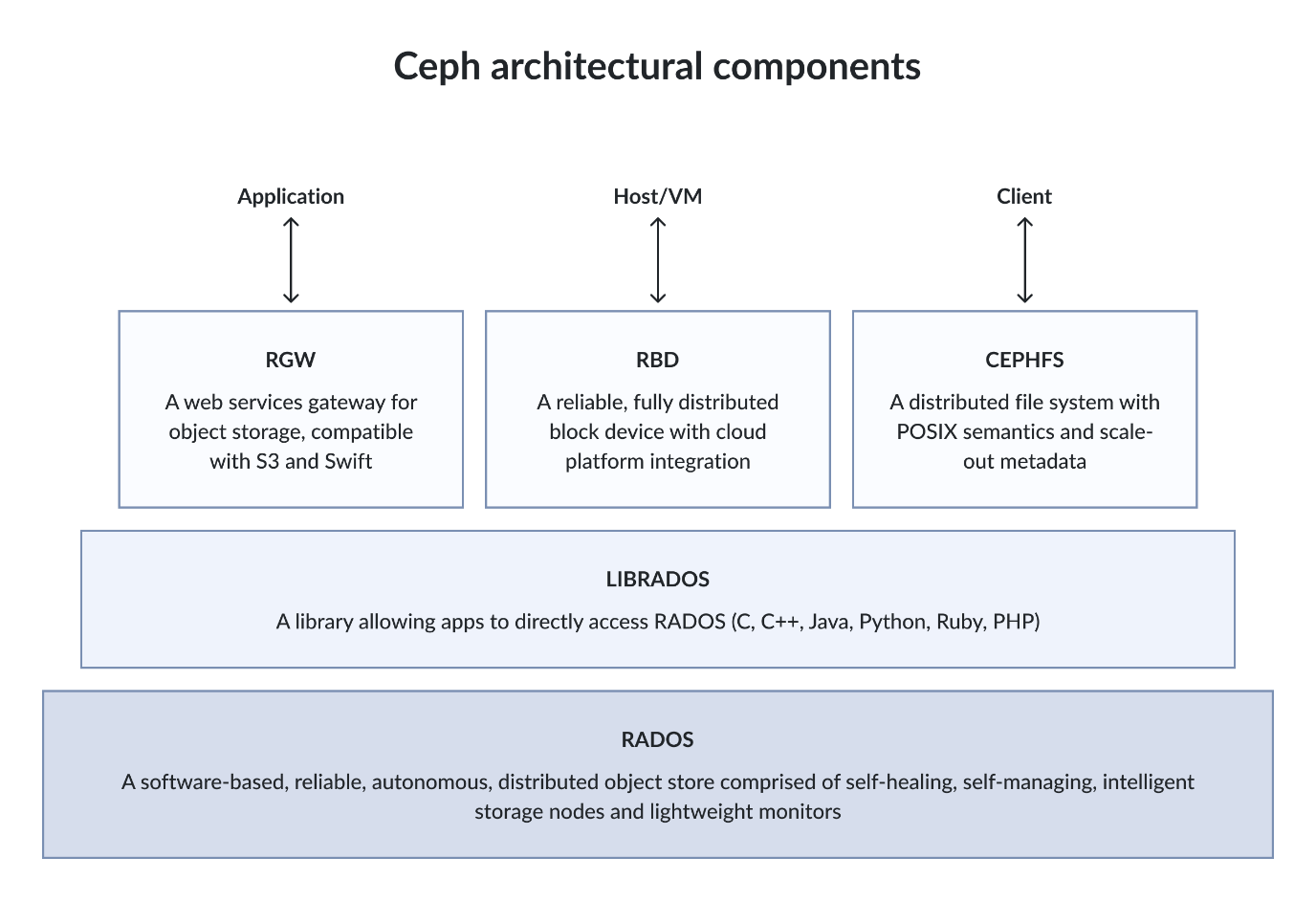
Ceph operates as a distributed storage system designed to store data across multiple nodes without relying on a centralized controller. At its core is RADOS (Reliable Autonomic Distributed Object Store), a distributed object storage layer that underpins all Ceph functionality, providing object storage capabilities, data replication, erasure coding, and failure recovery mechanisms. Rather than acting as a standalone service, RADOS is a logical storage layer implemented by a set of distributed daemons. Ceph exposes this storage through three primary interfaces:
Object storage
Ceph object storage is provided through its RGW (RADOS Gateway) which delivers object storage compatible with S3 and Swift APIs. If you work with cloud-native applications, this is the interface you will most likely interact with.
Block storage
Ceph’s block storage is provided by RBD (RADOS Block Device) that can be used by virtual machines and databases, similar to a traditional disk. This makes it a good option if you’re running virtualization platforms or stateful workloads.
File storage
Ceph file storage is available as CephFS, which provides a POSIX-compliant file system. CephFS allows users to store and retrieve files hierarchically, similar to traditional file systems, but with the added benefits of Ceph’s distributed architecture.
When a client interacts with Ceph – whether mounting a filesystem, attaching a block device, or sending an object request – the operation is passed to the cluster through a client library such as librados. Librados is a low-level client library that provides direct programmatic access to the RADOS object store, enabling applications to interact with Ceph clusters without intermediary layers.
The critical design choice: Ceph doesn’t use centralized metadata tables to track where data lives. Instead, it uses the CRUSH algorithm to compute data placement. CRUSH stands for Controlled Replication Under Scalable Hashing, and it lets clients and OSDs independently calculate where any object should be. That eliminates lookup bottlenecks and is why Ceph scales linearly. Data is replicated or erasure-coded across multiple nodes, so the cluster keeps running when disks or entire nodes fail. When we first encountered this architecture, the lack of a central controller was the thing that stood out most. Everything else flows from that decision. Such design allows Ceph to achieve high availability, self-healing, and automatic data distribution.
Though Ceph can be configured to run from a single server, it’s not how it is supposed to work. For the feasible production-ready deployment, Ceph requires a minimum of 3 servers that are connected to one another in what is called a cluster. Each connected server within that cluster network is referred to as a node.
Ceph components
Ceph is built as a layered, distributed architecture in which storage functionality is separated into logical and operational components.
A defining element of Ceph’s architecture is the use of the CRUSH algorithm to deterministically calculate where data should reside. Based on the cluster topology and policies, CRUSH maps data to placement groups (PGs), which are then assigned to specific Object Storage Daemons (OSDs).
Besides OSDs, Ceph uses several other core daemons that run across the same set of cluster nodes and perform distinct roles. These daemons collectively implement the RADOS storage layer and provide cluster coordination, data durability, and management functionality.
The key daemons in a Ceph cluster are:
- Object Storage Daemons (OSDs) are responsible for storing and managing actual data, handling data persistence, replication or erasure coding, and recovery. Each OSD typically corresponds to a physical or logical storage device. A minimum of three OSDs is recommended for a production cluster.
- Metadata servers (MDS) handle filesystem metadata such as directory hierarchy, file names, and timestamps for the CephFS filesystem. Importantly, MDS is only involved in metadata operations for CephFS, while actual file data is stored in RADOS and accessed directly from OSDs via the client layer. This separation allows CephFS to scale metadata and data operations independently.
- Ceph monitors (MONs) maintain the cluster state, including the cluster map and configuration, ensuring consistency through quorum. They store the cluster map, which is used by clients and daemons to make data placement decisions via the CRUSH algorithm. For more details on Ceph MONs, refer to the dedicated documentation.
- Ceph managers (MGR) provide monitoring and management capabilities, including metrics collection, system state visibility, and integration with external tools. They run alongside monitor daemons but are not part of the data path.
- RADOS Gateways (RGW) expose the object storage layer through an HTTP interface compatible with Amazon S3 and OpenStack Swift APIs, acting as a client-facing service built on top of RADOS.
Ceph Storage Operating Principles
Ceph distributes data across multiple nodes using the CRUSH algorithm. Here’s how it works:
- Data placement and replication: The CRUSH algorithm distributes files based on the CRUSH map and the object’s hash. This means CRUSH selects optimal storage locations based on predefined criteria, and files are duplicated and stored on physically separate media according to replication parameters specified by a system administrator. Files are organized into placement groups (PGs), and their names are processed as hash values. Each object is assigned to a PG, and the PG is then mapped to specific OSDs. This reduces management overhead and helps scale efficiently. For you as an operator, this means both clients and OSDs can independently determine data locations without querying a central service. As a result, Ceph avoids metadata bottlenecks and maintains consistent performance at scale.
- Data retrieval: To read data, Ceph uses an “allocation table” called the CRUSH map to locate an OSD containing the requested file. The CRUSH map contains cluster topology, OSD weights, and placement rules. Using this map, a client can compute exactly which OSD(s) hold a given PG, and therefore, the object. No central coordinator is needed.
- Self-healing: If a node or OSD fails, Ceph automatically rebalances data across healthy nodes and restores the initial number of data copies. Combined with replication or erasure coding, this ensures that data remains available even in the event of hardware failures.
Modern Deployment Model: cephadm and orchestration
One of the most significant changes in Ceph in recent years is the shift to a fully containerized deployment model.
Modern Ceph clusters are deployed and managed using cephadm, which orchestrates Ceph services as containers. This is tightly integrated with the Ceph Orchestrator, enabling declarative management of cluster services.
You define the desired cluster state and the orchestrator deploys services accordingly. This simplifies deployment, scaling, and upgrades. The older ceph-deploy tool is deprecated and shouldn’t be used for new clusters. We’ve migrated clusters from ceph-deploy to cephadm, and the difference in day-to-day operations is real. The orchestrator API is also what Proxmox hooks into for its Ceph integration, which comes up later.
Benefits and challenges of Ceph
Advantages
Ceph offers a number of important benefits that make it a good choice for modern software-defined storage:
- Scalability: Ceph scales horizontally without architectural changes. Capacity and performance can be increased by adding more nodes, allowing clusters to grow from a few terabytes to petabyte- and exabyte-scale deployments.
- High availability and self-healing: Ceph automatically replicates or encodes data across multiple nodes. In case of hardware failures, the system rebalances and recovers data without manual intervention. Because there is no central controller in the data path, resilience and scalability are improved.
- Multiple storage protocol support and hardware flexibility: Ceph provides block (RBD), file (CephFS), and object (RGW) storage within a single system, all backed by the same RADOS layer. Ceph runs on commodity hardware, eliminating the need for proprietary storage appliances and significantly reducing capital expenses.
- Strong ecosystem and open-source model: Ceph is open-source and actively developed, with commercial support available from vendors such as Red Hat.
Challenges:
However, implementing Ceph comes with its own set of challenges:
- Operational complexity: Ceph has a steep learning curve. If you plan to run it in production, proper understanding of concepts such as CRUSH maps, placement groups, failure domains, and recovery behavior is required to design and operate a stable cluster.
- Infrastructure requirements and performance sensitivity to design: Production environments typically require high-performance networking (at least 10 GbE, often 25 GbE and higher), as well as sufficient CPU and memory resources – especially for all-flash or erasure-coded deployments. Ceph performance depends heavily on hardware and configuration – not well-planned deployments may suffer from high latency and inconsistent throughput.
- Resource overhead and cluster limitations: While Ceph can run on three nodes, it typically delivers better stability and performance with four or more nodes. This makes it less practical for small setups with 2-3 nodes, which are common in small and medium-sized environments. Ceph also introduces additional overhead due to replication, networking, and distributed coordination, which must be accounted for during sizing.
- Mixed workload require tuning: Achieving optimal performance for mixed workloads (e.g., 4-8K small random I/O typical for virtualization) usually requires careful tuning and operational experience. Out of the box, Ceph isn’t optimized for this.
Ceph in Proxmox VE
Proxmox Virtual Environment (VE) includes built-in support for Ceph, making it a popular option for deploying hyperconverged infrastructure. In such setups, each node contributes local storage to a shared Ceph cluster, while virtual machine disks are stored as RBD images, enabling live migration and high availability without external storage.
Although Proxmox simplifies deployment through its UI, it does not remove Ceph’s inherent complexity. You still need at least three nodes, high-speed networking, and a solid understanding of concepts like CRUSH, placement groups, and failure domains to build a stable setup.
For small environments, these requirements can be excessive. If you’re working with limited resources or a small cluster, simpler solutions like StarWind Virtual SAN (VSAN) are often a better fit. StarWind can run on just two nodes, is easier to deploy and manage, and provides high availability without the operational overhead of Ceph.
Ceph vs. StarWind Virtual SAN
TLDR: Ceph and StarWind VSAN are designed for different problems.
Ceph is better suited for large-scale, distributed environments where flexibility and scalability are critical. It fits cloud platforms, multi-tenant infrastructures, and deployments that require object, block, and file storage within a single system.
StarWind Virtual SAN focuses on simplicity and performance in smaller environments. It can provide tier-1 highly available shared storage with only two nodes, which is not feasible with Ceph due to quorum requirements.
This difference has practical implications. Deploying and operating Ceph requires a higher level of expertise, particularly when tuning performance and managing data placement. StarWind focuses on ease of use, allowing organizations to achieve high availability with minimal configuration and operational overhead.
If your priority is simplicity and fast deployment, StarWind often provides a more straightforward path to reliable shared storage, especially in small and mid-sized environments.
When comparing Ceph with StarWind Virtual SAN (VSAN), several distinctions become evident:
| Feature | Ceph | StarWind Virtual SAN |
|---|---|---|
| Deployment complexity | Requires careful design, planning, and expertise | Quick and straightforward deployment with minimal expertise required |
| Minimum nodes | 3 nodes minimum (4 – 5 recommended for stability) | 2 nodes with optional witness |
| Time to production | Days (depending on expertise) | Hours |
| Management | CLI-heavy, requires familiarity with Ceph internals | User-friendly WebUI and GUI |
| Operational overhead | High (continuous tuning and monitoring required) | Low (designed for easy day-to-day operations) |
| Performance consistency | Depends heavily on design and tuning | Predictable and stable out-of-the-box |
| Scalability | Virtually unlimited (ideal for large-scale deployments) | Scales for SMB and mid-size environments |
| Storage types | Block, file, and object storage | Block storage optimized for virtualization |
| Resilience model | Replication or erasure coding (complex configuration) | Simple synchronous mirroring |
| Best use case | Large-scale clusters, cloud, service providers | Small to medium environments, edge, ROBO |
| Fit for Proxmox | Powerful but often overkill for small clusters | Ideal for simple, highly available Proxmox setups |
While Ceph provides a versatile and scalable solution, StarWind VSAN with NVMe-oF highly-available devices, offers strong performance characteristics, particularly for virtual machine storage use cases. If you want a deeper technical breakdown,, refer to the “DRBD/LINSTOR vs Ceph vs StarWind VSAN: Proxmox HCI Performance Comparison” article.
FAQ
- What does Ceph stand for?
Ceph stands for “Cephalopod,” inspired by intelligent marine animals known for their distributed nervous system, reflecting Ceph’s distributed architecture. - What is the function of Ceph?
Ceph decouples data from physical storage hardware through software abstraction layers, providing impressive scalability and fault management. This makes Ceph great for large private cloud environments, OpenStack, Kubernetes, and other container-based workloads. - What is the difference between NFS and Ceph?
NFS (Network File System) is a file-level protocol that allows clients to access shared storage over a network. It is typically used for straightforward file sharing and relies on a centralized server or cluster.
Ceph, in contrast, is a distributed storage system that provides block, file, and object storage through a unified platform. It is designed for scalability, fault tolerance, and high availability, making it suitable for more demanding and large-scale workloads.
You can use CephFS namespaces with the NFS-Ganesha server to export them over the NFS protocol. This way, you get the simplicity of NFS with the scalability of Ceph. However, it is important to note that NFS is just an access protocol, whereas Ceph is a full storage platform.
Conclusion
Ceph is quite hard to beat when you actually need what it could offer: petabyte scale, self-healing, 3x storage interfaces from one cluster, and no vendor lock. The catch is that it asks for a real investment up front: 3x nodes minimum, fast networking, and someone on the team who understands placement groups and tuning performance for the required workload profile.
For smaller deployments, such math rarely works out. A 2-node StarWind VSAN setup will give you HA shared storage in an afternoon and stay out of your way. The reverse is also true – if you’re running OpenStack or a multi-petabyte object store, StarWind isn’t the answer.
All in all – choose the product for the scale you actually have, not the one with the bigger spec sheet.
Meta: What is Ceph and how does it work? Explore Ceph architecture, understand the role of RADOS and CRUSH. Learn Ceph key benefits, challenges, and use cases. Discover why StarWind VSAN is often a better fit for 2-node clusters.